How to Squat: Complete Form Guide
11 min read · September 2026 · by Manikanta Sirumalla
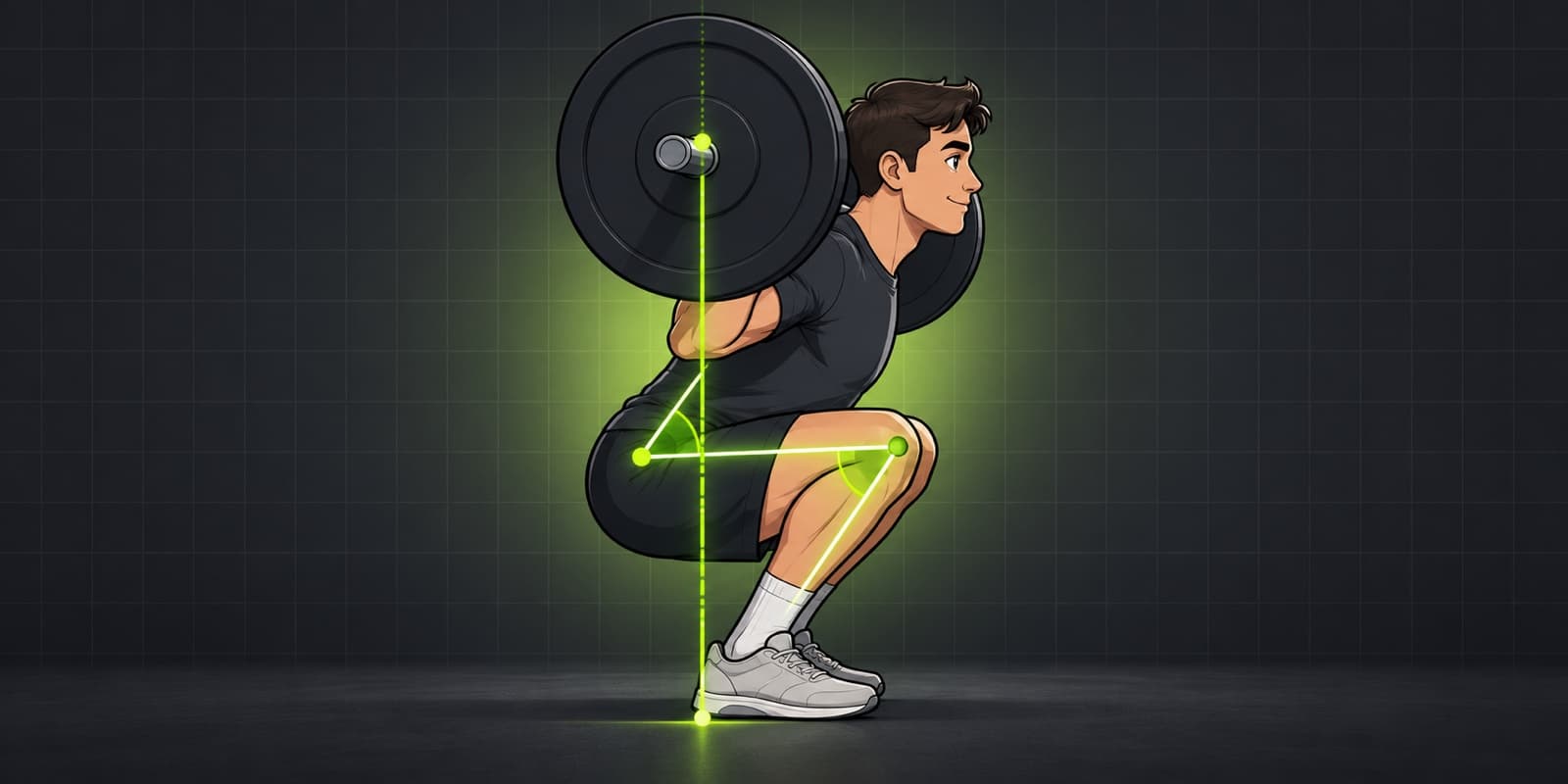
The barbell squat trains more muscle than any other single exercise, builds the legs, hips and trunk, loads the spine and hips for bone, and transfers to almost every athletic and daily movement. It is also technical enough that most people never learn it properly, and the folklore around it (knees behind toes, never below parallel, look at the ceiling) has made it worse. This guide sets out the technique the research and the best coaches agree on.
What the squat trains
The back squat is primarily a knee and hip extension exercise. The quadriceps extend the knee; the glutes and adductors extend the hip; the hamstrings stabilise; the erectors, abdominals and obliques hold the trunk rigid; the upper back supports the bar. Full-depth squats have been shown to produce greater growth in the quads, glutes and adductors than half squats, with the glute and adductor difference being especially large (Kubo et al. 2019; Bloomquist et al. 2013).
Setup
Bar height. Set the rack so the bar is at about mid-chest height. Too high and you will have to rise onto your toes to unrack; too low and you waste energy standing up with it.
Bar position. Two options, covered in detail below. For a high bar squat, the bar sits on the top of the trapezius, just below the bony bump at the base of the neck. For a low bar squat, it sits about 5 to 8 cm lower, across the rear deltoids and in the shelf formed by squeezing the shoulder blades together. Either way, never on the neck itself.
Grip. Hands as close to the shoulders as your shoulder mobility allows, evenly spaced. A narrower grip builds a tighter upper back shelf; a wider grip is easier on stiff shoulders. Wrists should be as straight as possible. If wrists bend back sharply under the bar, widen the grip or improve shoulder mobility.
Unrack. Step under the bar so it sits on your back with your feet directly under it. Take a big breath, brace, and stand it up by extending the legs. Take two or three small steps back, not a walk, and set your feet.
Stance
Width. Roughly shoulder width, measured at the heels, as a starting point. Wider stances shift work to the hips and adductors; narrower to the quads. Individual hip anatomy varies a lot, so experiment in a range from hip width to slightly wider than shoulder width and keep whatever lets you squat deepest with a neutral spine.
Toe angle. Turned out 15 to 30 degrees. Toes pointing straight ahead forces the knees to track in a narrower channel and often limits depth; toes flared far out reduces quad involvement. The knees should track over the toes throughout, so the toe angle sets the knee path.
Weight distribution. Over the middle of the foot, balanced between heel and ball. The whole foot stays flat. The heels never rise.
Bracing and breathing
The trunk has to be rigid to transfer force from the legs to the bar without the spine bending. This is done with intra-abdominal pressure:
- Before each rep, take a deep breath into the belly, not the chest.
- Brace the abdominal wall outward against a belt if wearing one, or as if bracing for a punch.
- Hold the breath through the descent and the hardest part of the ascent.
- Exhale as you pass the sticking point or at the top.
This is the Valsalva manoeuvre. It raises blood pressure briefly and is safe for healthy people; it is what every strength athlete does under heavy load. If you have uncontrolled hypertension or certain heart conditions, consult a doctor about breathing patterns.
A lifting belt gives the abdominal muscles something to brace against and increases intra-abdominal pressure. It is a useful tool for heavy sets, not a substitute for learning to brace.
The descent
- Set the eyes on a point on the floor a few metres ahead. Neutral neck.
- Begin by pushing the hips back slightly and bending the knees at the same time. The two happen together; a squat is not a hinge followed by a knee bend.
- Push the knees out in line with the toes as you descend.
- Let the knees travel forward as far as they need to. For most people, they will pass the toes at depth; this is correct.
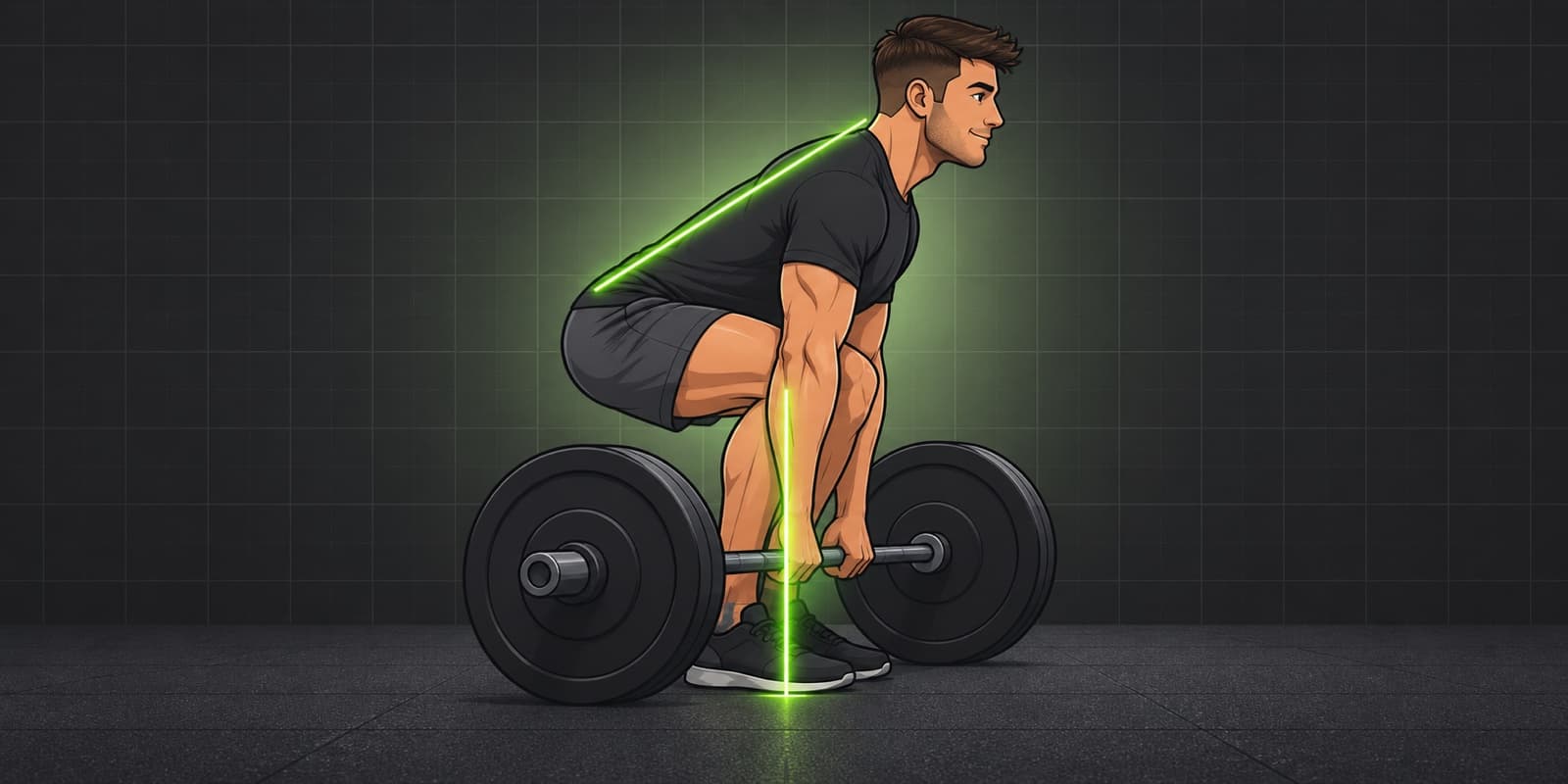
- Keep the bar over the middle of the foot, which means the torso leans forward to whatever degree your build requires. Long-femured lifters lean more.
- Descend under control, about one to two seconds, to depth.
Depth. The standard is the hip crease at or below the top of the knee, which is parallel. Deeper is better if you can maintain a neutral spine and a flat foot. Full-depth squats do not harm healthy knees; a review of the biomechanical evidence found that the forces on the knee structures at deep angles are well within tolerance and that deep squats are safe and effective (Hartmann et al. 2013). Depth is limited by mobility and technique, not by safety.
The bottom. A brief pause or a controlled reversal. Bouncing off the calves is a competition technique that most people should not use.
The knees-past-toes myth
For decades, gym rules said knees should never pass the toes. The origin is a 1978 study that found knee forces were lower when forward knee travel was restricted. What the rule ignored was where the force went instead. Fry and colleagues tested it directly: restricting the knees from passing the toes reduced knee torque by about 22 percent and increased hip torque by about 1,000 percent, along with a much greater forward lean and more load on the lower back (Fry et al. 2003). Knees moving forward is normal, necessary for depth in most people, and safer for the whole system than the alternative.
The ascent
- Drive the whole foot into the floor, thinking about pushing the floor away.
- Hips and shoulders rise together at the same rate. The most common fault is the hips shooting up first, which turns the squat into a good morning and loads the lower back.
- Keep pushing the knees out; they tend to cave inward (valgus) as fatigue sets in.
- Keep the bar over mid-foot; if the weight goes to the toes, you will tip forward.
- Stand to full hip and knee extension without hyperextending the back.
- Reset the breath and brace before the next rep.
Common faults and fixes
| Fault | Cause | Fix |
|---|---|---|
| Hips rise first, chest drops | Weak quads or poor bracing; too much forward lean | Cue "chest up, drive the head into the bar"; pause squats; strengthen quads with front squats |
| Knees cave inward | Weak hip abductors, fatigue, poor cue awareness | Cue "spread the floor"; push knees out; band around knees for warm-ups; reduce load |
| Heels rise | Poor ankle mobility, too narrow a stance, trying to keep shins vertical | Elevate heels (shoes, plates); widen stance and toe angle; ankle mobility work |
| Excessive butt wink | Squatting past hip mobility; poor bracing; narrow stance | Squat to neutral-spine depth; widen stance; brace before descending; hip mobility |
| Leaning too far forward | Weak upper back or trunk; low bar with high bar cues; bar too high on neck | Check bar position; strengthen trunk and upper back; front squats to teach uprightness |
| Cutting depth | Load too heavy; fear; mobility | Reduce load; box squats to a parallel box; film sets from the side |
| Rounding upper back | Loose shelf, weak upper back, hands too wide | Narrow the grip; squeeze shoulder blades; upper back work |
Film yourself from the side and from a 45-degree front angle. Most faults are obvious on video and invisible from the inside.
High bar vs low bar vs front squat vs goblet squat
High bar back squat. Bar on the traps. More upright torso, more knee flexion, more quad emphasis. The default for general training and hypertrophy, and easier to learn. Used by weightlifters.
Low bar back squat. Bar on the rear delts. More forward lean, more hip flexion, more hip and back involvement. Lets most people lift 5 to 10 percent more, and is the choice for powerlifting. Harder on shoulder and wrist mobility. Muscle activation differences between the two are smaller than the folklore suggests (Glassbrook et al. 2017); both build the legs.
Front squat. Bar on the front of the shoulders. Very upright, maximal quad emphasis, less load, and it teaches the upright torso and knee-forward position that many back squatters lack. Excellent for quads and as a teaching tool.
Goblet squat. A dumbbell or kettlebell held at the chest. The best way to learn the squat pattern: the front load keeps the torso upright and the elbows push the knees out at the bottom. Beginners should spend their first weeks here. See How to Start Working Out.
Safety bar, box squat, Zercher, split squat. Useful variations for specific goals and limitations, all built on the same principles.
Programming the squat
- Beginners: 3 sets of 5 to 8 reps, two or three times a week, adding 2.5 kg per session while form holds. See Full Body Training.
- Hypertrophy: 3 to 5 sets of 6 to 12 reps, one or two sessions a week, with a variation on a second day. See Training Volume.
- Strength: 3 to 6 sets of 2 to 5 reps at 80 to 90 percent, with lighter volume work. See Strength vs. Hypertrophy.
- Warm-up: empty bar, then 40, 60, 80 percent of the working weight for decreasing reps. See How to Warm Up Properly.
- Safety: squat in a rack with safeties set just below your depth, or with spotters. Never squat heavy in a Smith machine as a substitute for learning the free-weight pattern.
The bottom line
Bar on the upper back, feet shoulder width with toes out, big breath and brace, sit down by bending hips and knees together, knees out and forward, bar over mid-foot, to parallel or deeper, then drive the floor away with hips and chest rising together. Full depth is safe and builds more muscle, knees past toes is normal, and the most common fault is the hips rising first. Film your sets, fix one thing at a time, and add weight slowly.
Sources
- Kubo K, Ikebukuro T, Yata H. "Effects of squat training with different depths on lower limb muscle volumes." European Journal of Applied Physiology, 2019.
- Bloomquist K, Langberg H, Karlsen S, et al. "Effect of range of motion in heavy load squatting on muscle and tendon adaptations." European Journal of Applied Physiology, 2013.
- Hartmann H, Wirth K, Klusemann M. "Analysis of the load on the knee joint and vertebral column with changes in squatting depth and weight load." Sports Medicine, 2013.
- Fry AC, Smith JC, Schilling BK. "Effect of knee position on hip and knee torques during the barbell squat." Journal of Strength and Conditioning Research, 2003.
- Glassbrook DJ, Helms ER, Brown SR, Storey AG. "A Review of the Biomechanical Differences Between the High-Bar and Low-Bar Back-Squat." Journal of Strength and Conditioning Research, 2017.
- Schoenfeld BJ. "Squatting kinematics and kinetics and their application to exercise performance." Journal of Strength and Conditioning Research, 2010.
- Myer GD, Kushner AM, Brent JL, et al. "The back squat: A proposed assessment of functional deficits and technical factors that limit performance." Strength and Conditioning Journal, 2014.
Frequently asked questions
How deep should I squat?
To at least parallel, where the hip crease is level with the top of the knee, and deeper if your mobility allows. Full-depth squats produce greater muscle growth in the quads and glutes than partial squats in controlled trials and do not increase injury risk in healthy knees. Depth is limited by mobility and technique, not by safety.
Is it bad for your knees if they go past your toes?
No. Knees travelling forward past the toes is a normal part of a deep squat, especially for people with long thighs. Restricting it shifts load to the hips and lower back. The old advice came from a 1970s study that measured knee forces without considering the trade-off; later research showed the restriction increases hip and spine torque substantially.
High bar or low bar squat?
High bar (bar on the traps, more upright torso, more knee bend) emphasises the quads and is easier to learn. Low bar (bar on the rear delts, more forward lean, more hip hinge) lets most people lift more and emphasises hips and back. Both build the legs. Pick high bar for general training and quads, low bar for powerlifting or if it feels more natural.
Why do my heels come up when I squat?
Limited ankle dorsiflexion, a stance that is too narrow, or trying to keep the shins vertical. Fixes: turn the toes out slightly more, widen the stance a little, elevate the heels with lifting shoes or small plates, and work on ankle mobility with loaded calf stretches. Heel-elevated squats are a legitimate long-term option.
How do I stop my lower back rounding at the bottom (butt wink)?
A small posterior pelvic tilt at the very bottom is normal and harmless. A large one under load comes from squatting past your hip mobility, a narrow stance, or poor bracing. Squat to the depth where your spine stays neutral, brace properly before descending, and gradually work deeper as mobility improves.
Should I look up or down when squatting?
Keep a neutral neck and look at a point on the floor a few metres ahead. Looking up extends the neck and tends to pull the chest up and the hips forward, which can disturb the bar path. Looking straight down encourages rounding. Neutral is the default in most coaching systems.