How to Start Working Out: A Beginner's Guide to the Gym
11 min read · September 2026 · by Manikanta Sirumalla

Most people who join a gym in January have stopped going by March. The reason is rarely laziness. It is that they walked in without a plan, did too much, got very sore, felt out of place, and had no way to tell whether anything was working. Every one of those problems is solvable before your first visit. This guide solves them.
Before you go: decide what you are doing
The single biggest predictor of whether a beginner keeps going is whether they walk in with a plan. Not a vague intention to "do some weights and some cardio," but a list of exercises, sets and reps that fits on a phone screen.
Here is the plan. It is the same one strength coaches have given beginners for decades, because it works.
Three full-body sessions a week, on non-consecutive days. Each session:
| Movement pattern | Exercise options | Sets x reps |
|---|---|---|
| Squat | Goblet squat, leg press, box squat | 3 x 8 to 12 |
| Hinge | Dumbbell Romanian deadlift, trap bar deadlift, hip thrust | 3 x 8 to 12 |
| Push | Dumbbell bench press, machine chest press, push-up | 3 x 8 to 12 |
| Pull | Seated cable row, lat pulldown, assisted pull-up | 3 x 8 to 12 |
| Carry or core | Farmer's carry, plank, dead bug | 3 x 30 to 45 seconds |
Rest two minutes between sets. Pick one exercise per row and keep the same choices for at least four weeks so you can measure progress. Total time, including a warm-up: 45 to 60 minutes.
Why this structure: full-body training three times a week gives each muscle three growth stimuli per week, which is the sweet spot for beginners, and compound movements train many muscles per set, so five exercises cover the whole body. The evidence for training a muscle two or more times per week and for compound lifts is covered in Full Body Training: Why Beginners Should Start Here and The 10 Best Compound Exercises.
How heavy. Choose a weight where the last rep of each set is hard but you could do two or three more with good form. That is an RPE of about 7 out of 10. Too light is fine for the first two weeks while you learn the movement. Too heavy is how beginners get hurt and get so sore they quit. See RPE Training.
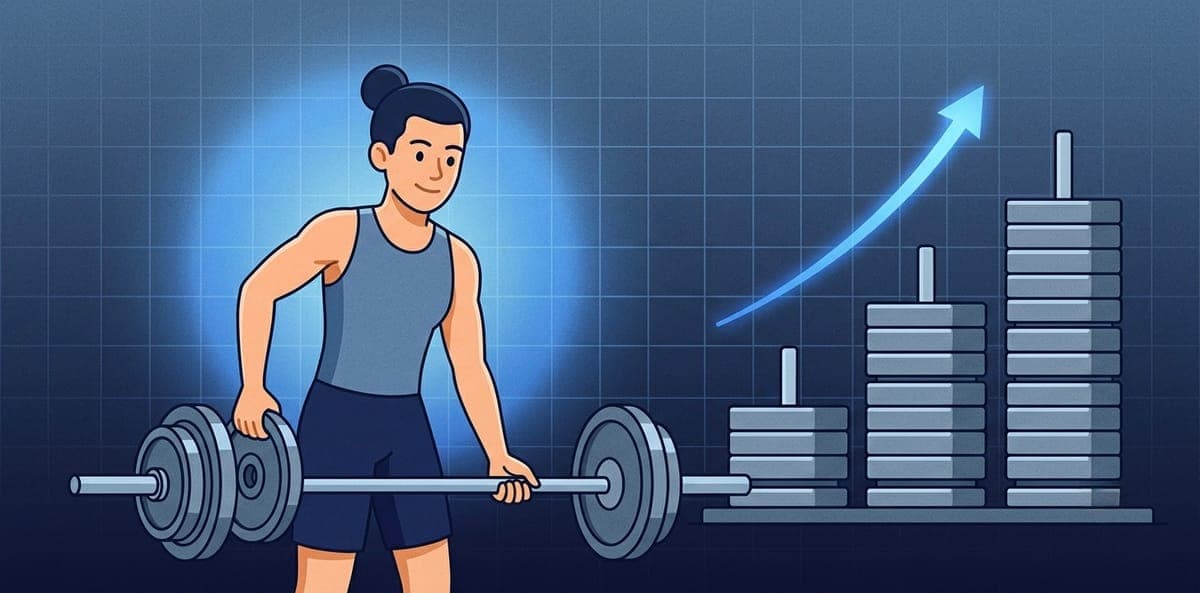
How to progress. When you complete all sets at the top of the rep range with clean form, add the smallest weight increase available (usually 2.5 kg on a barbell, 2 kg on dumbbells, one plate on a machine). This is progressive overload, and it is the entire mechanism of getting stronger. See Progressive Overload.
Your first day
Your first session is not a workout. It is a reconnaissance mission. Go at a quiet time. Walk in, find the changing rooms, find the water fountain, and locate the equipment you need. Ask a staff member to show you how to adjust the seat on the chest press and the row. That is a normal request and they do it fifty times a week.
Then do this:
- Five minutes on a bike or treadmill at an easy pace.
- One or two light sets of each of your five exercises. Learn the movement. Note the weight you used.
- Leave.
You will feel like you did nothing. That is the point. You now know where everything is, how the machines work, and that nothing terrible happened. Day two, in 48 hours, is the first real session, and it will be easier because day one removed the unknowns.
Gym anxiety is normal and it goes away
Nearly every beginner feels it: the sense that everyone is watching, that you will use a machine wrong, that you do not belong. Some practical truths:
- Nobody is watching you. Experienced lifters are focused entirely on their own session. If they notice you at all, it is with mild approval that you are there.
- Competence cures it. After four to six sessions, your five exercises will feel routine, and the anxiety will be about a tenth of what it was. It is a temporary tax.
- Go at quiet times for the first two weeks. Mid-morning, early afternoon and after 8 pm are usually calm.
- Have the plan on your phone. Standing around deciding what to do next is the most uncomfortable part; a written plan removes it.
- Use the free-weight area early. Many beginners hide on machines for months because the free-weight area feels intimidating. Go there in week two, with a dumbbell exercise you know. The barrier is imaginary and it shrinks the moment you cross it.
- Etiquette is simple. Put weights back. Wipe down equipment. Do not sit on a machine scrolling your phone between sets. Ask "are you using this?" before taking equipment. That is the entire code.
What to expect, week by week
Weeks 1 to 2. Sore. Every muscle, one to three days after each session. This is delayed onset muscle soreness, and it is a response to novel movement, not damage, and not a measure of a good session. It reduces dramatically after the first two weeks through what physiologists call the repeated bout effect. Keep the weights light, keep the sessions short, keep going. See Muscle Soreness (DOMS).
Weeks 3 to 6. Strength rises fast, often 5 to 10 percent per week on some exercises. This is mostly your nervous system learning to recruit the muscle you already have, not new muscle. Enjoy it; it is the fastest progress you will ever make.
Weeks 6 to 12. Visible changes begin. Real muscle growth is measurable from around week 4 to 6, and by 8 to 12 weeks other people notice. Strength gains slow from weekly to every two or three weeks, which is normal. See How Long Does It Take to Build Muscle.
Months 3 to 6. You are no longer a beginner. Consider a four-day upper/lower split, add exercises, and start reading about volume and periodisation. See How to Pick the Right Training Split.
Eat like someone who trains
You do not need a special diet to start. You need three things:
- Protein. About 1.6 g per kilogram of body weight a day, from meat, fish, eggs, dairy, legumes or a shake. This is the material muscle is built from and most beginners eat half of it. See How Much Protein Do You Actually Need.
- Enough food. If your goal is to build muscle, eat at or slightly above maintenance. If your goal is fat loss, a modest deficit of 300 to 500 calories, no more. Beginners can do both at once for a while. See Body Recomposition and the TDEE Calculator.
- Something before training. A meal one to three hours before, or a small snack with carbohydrate 30 to 60 minutes before, makes sessions noticeably better.
Supplements are not required. Creatine is the one worth considering once you have a month of consistent training behind you. See Supplements That Actually Work.
The rest of the week
- Walk. 7,000 to 10,000 steps a day on all days. It is the cheapest fitness available and helps recovery.
- Sleep. Seven to nine hours. Muscle is built during sleep, and sleep-deprived beginners progress slower and get injured more.
- Cardio. Optional in the first month while your body adapts to lifting. After that, one or two easy 20 to 30 minute sessions a week for heart health. See Zone 2 Training.
- Rest days. Real rest between lifting days. Beginners recover fast, but three sessions a week with a day between each is the structure that works.
The mistakes that make beginners quit
- Doing too much too soon. Six days a week, ten exercises a session, and training to failure produce the soreness and burnout that end most gym memberships. Three days, five exercises, two reps in reserve.
- Program hopping. Changing exercises every week means you can never tell if you are progressing. Keep the same five exercises for a month.
- Not tracking. If you do not write down the weight and reps, you cannot progressively overload, and progressive overload is the whole game. Use a notebook or an app.
- Judging by the scale. Muscle gain and fat loss can cancel on the scale for months. Judge by strength, measurements and photos.
- Waiting to feel motivated. Motivation follows action, not the other way around. Schedule sessions like appointments and go when you do not feel like it. Eight weeks of consistency turns it into a habit.
- Copying advanced lifters. The person doing drop sets and forced reps has ten years of adaptation you do not. Their program is wrong for you.
- All-or-nothing thinking. A missed session is a missed session, not a failed plan. Go to the next one.
When to get help
A few sessions with a good coach or trainer to learn the squat, hinge and press patterns is the best money a beginner can spend, and much cheaper than a year of ineffective training. Look for someone who teaches the basics and gives you a program, not one who sells you a complicated circuit designed to make you tired. The form guides here are a good complement: start with How to Squat and How to Deadlift.
The bottom line
Three full-body sessions a week, five compound exercises, two to three sets of 8 to 12 reps with two or three reps in reserve, and a small weight increase whenever you complete the sets cleanly. Eat enough protein, walk daily, sleep well, and track every session. Do that for eight weeks and you will be stronger than you have ever been, the gym will feel like a place you belong, and the habit will carry itself. Everything else in fitness is detail.
Sources
- Schoenfeld BJ, Ogborn D, Krieger JW. "Effects of Resistance Training Frequency on Measures of Muscle Hypertrophy: A Systematic Review and Meta-Analysis." Sports Medicine, 2016.
- Ralston GW, Kilgore L, Wyatt FB, Baker JS. "The Effect of Weekly Set Volume on Strength Gain: A Meta-Analysis." Sports Medicine, 2017.
- Iversen VM, Norum M, Schwarz TLE, Fimland MS. "No Time to Lift? Designing Time-Efficient Training Programs for Strength and Hypertrophy: A Narrative Review." Sports Medicine, 2021.
- Damas F, Phillips SM, Libardi CA, et al. "Resistance training-induced changes in integrated myofibrillar protein synthesis are related to hypertrophy only after attenuation of muscle damage." Journal of Physiology, 2016.
- Morton RW, Murphy KT, McKellar SR, et al. "A systematic review, meta-analysis and meta-regression of the effect of protein supplementation on resistance training-induced gains in muscle mass and strength in healthy adults." British Journal of Sports Medicine, 2018.
Frequently asked questions
What should I do on my first day at the gym?
Keep it short and simple. Walk in, do a 5-minute warm-up on a bike or treadmill, then a single set or two of five basic movements (goblet squat, dumbbell Romanian deadlift, dumbbell press, seated row, plank) with light weights to learn the patterns. Leave after 30 to 40 minutes feeling like you could do more. Day one is about coming back on day three.
How many days a week should a beginner go to the gym?
Three. Beginners adapt fast and recover fast, so three full-body sessions on non-consecutive days (for example Monday, Wednesday, Friday) provide the most progress per hour and are sustainable. Two is enough to make progress if three is too many; more than four adds little for a beginner.
How long should a beginner workout be?
45 to 60 minutes, including the warm-up. Five or six exercises at two to three sets each with two minutes of rest fits easily in that window. Longer sessions are a sign of too many exercises, not more results.
How do I deal with gym anxiety?
Go at quieter times at first (mid-morning, early afternoon or late evening), have a written plan so you are never standing around deciding, learn three or four machines and free-weight movements you can do confidently, and remember that almost nobody is watching you; they are watching themselves. Confidence follows competence, and competence takes about four to six visits.
Should I do cardio or weights as a beginner?
Weights first. Strength training builds the muscle that changes body composition and function, and beginners gain strength faster than at any other point. Add walking daily and one or two short easy cardio sessions for heart health. If your only goal is running, you can flip the priority, but most people benefit more from lifting.
How sore should I be after working out?
Mild to moderate soreness for one to three days is normal in the first two weeks and fades as your body adapts. Soreness that stops you walking normally means you did too much too soon. Reduce the volume slightly next time and keep training; soreness is not a measure of a good workout.