Romanian Deadlift (RDL) Guide: Form, Muscles Worked, and Programming
9 min read · September 2026 · by Manikanta Sirumalla
The Romanian deadlift is the purest hip hinge in the gym, and the best single exercise for the hamstrings and glutes that most people have access to. It is also one of the most commonly done badly: rounded backs, bent knees, bars drifting away from the legs, and lifters who feel it only in the lower back. This guide covers the hinge, the setup and range, the research on what it trains, and how to program it.
What the RDL trains
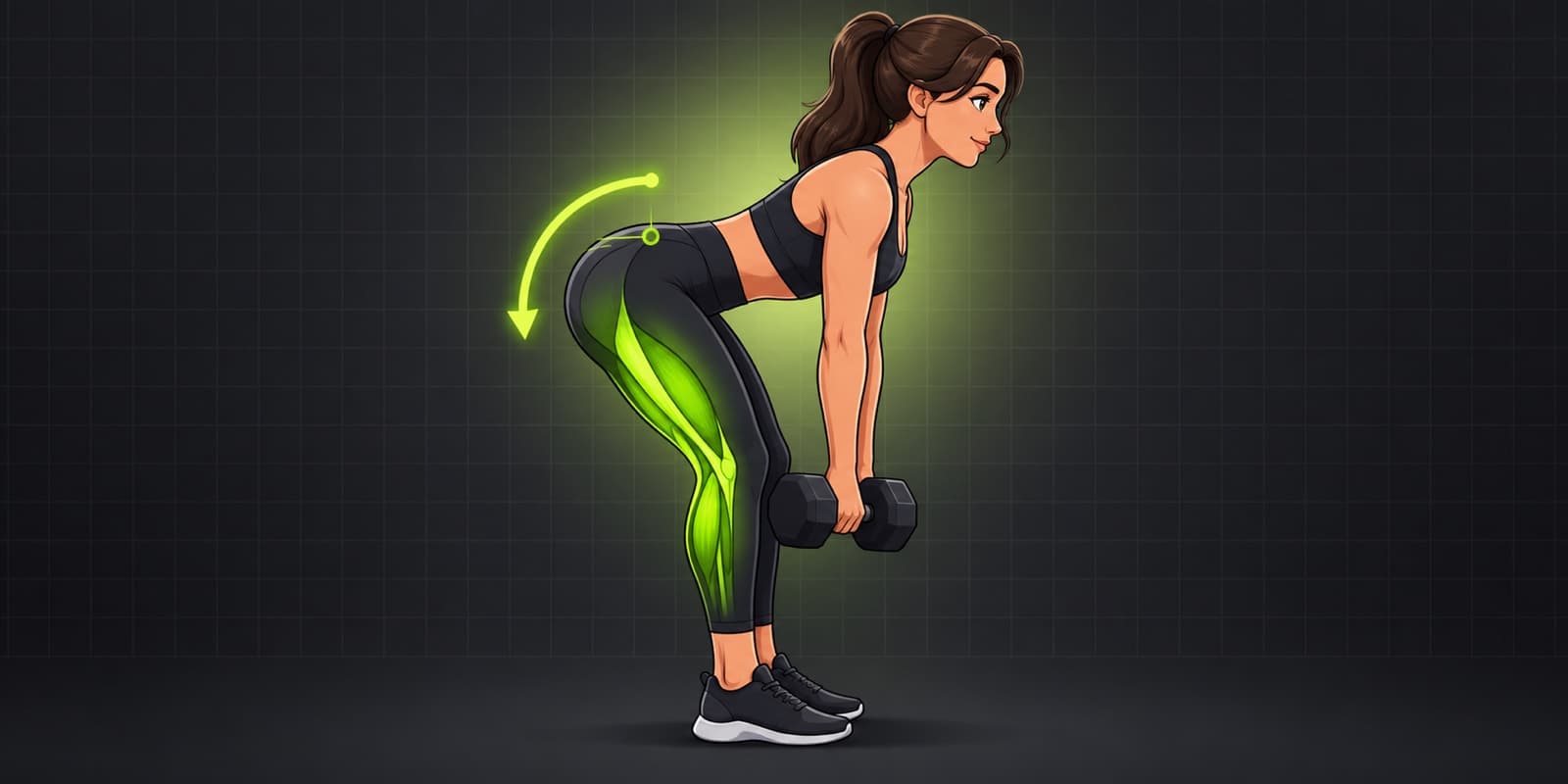
The RDL is hip extension with the knees nearly fixed. Lowering the bar stretches the hamstrings and glutes under load; standing up contracts them. Because the knees stay almost straight, the hamstrings work at long muscle lengths through the whole movement, which is where they grow best and where they need strength to resist injury.
EMG research places the RDL among the highest activators of the biceps femoris and semitendinosus of any hamstring exercise (Schoenfeld et al. 2015), and hip-extension exercises like the RDL preferentially develop the long head of the biceps femoris and the semimembranosus, the muscles most often strained in sprinting, whereas knee-flexion exercises like the Nordic curl develop the short head (Bourne et al. 2017). Training at long muscle lengths also produces more hypertrophy than training at short lengths in recent studies (Pedrosa et al. 2022), which makes the RDL's stretched bottom position the point.
The glutes extend the hip in the top half of the movement, the spinal erectors hold the back rigid isometrically, and the upper back and grip hold the bar. It is a posterior-chain exercise, not a lower-back exercise; if the back is what you feel, something is wrong.
Setup
Start from standing. Take the bar from a rack set at hip height, or deadlift it up from the floor once and begin from the top. The RDL starts at lockout, not from the floor.
Stance. Feet hip width, toes straight ahead or slightly out. Narrower than a squat stance.
Grip. Double overhand just outside the thighs. Straps are appropriate when grip limits the set, which it often will; the RDL is a hamstring exercise, not a grip test.
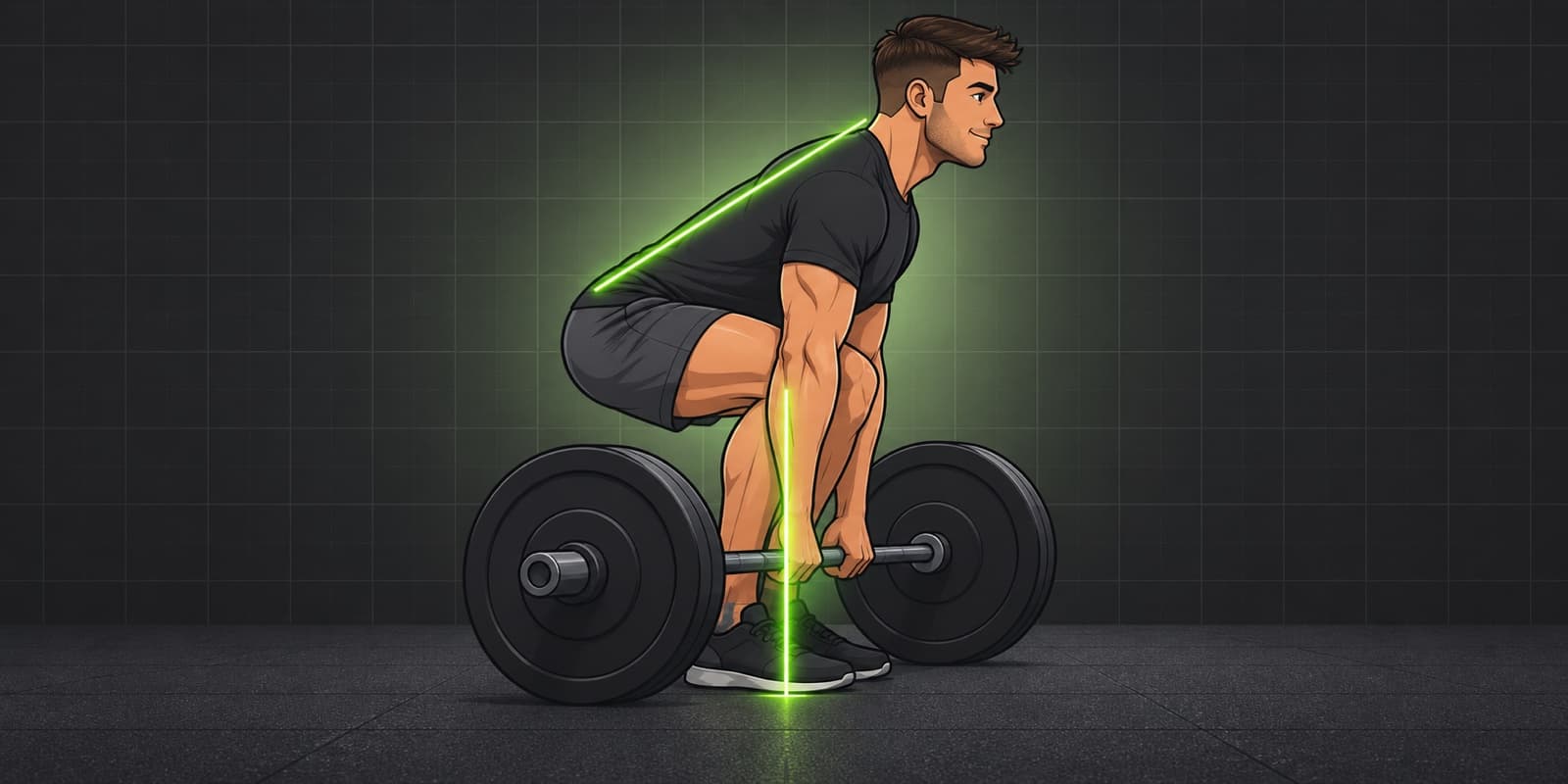
Knees. Unlock them to a soft bend, roughly 15 to 20 degrees, and keep that bend constant for the whole movement. The shins stay vertical.
Back. Chest up, shoulder blades pulled slightly down and back, neutral spine from neck to tailbone. Brace the trunk.
The movement
- Take a breath and brace.
- Push the hips straight back, as if closing a car door with your backside. The torso tilts forward because the hips move back, not because you bend at the waist.
- Keep the bar in contact with the thighs, dragging down the legs. As the hips go back, the bar goes down.
- Lower until you feel a strong stretch in the hamstrings while the back is still flat. For most people that is when the bar is at mid-shin, or just below the knee; for the flexible, lower; for the tight, above the knee. Flexibility sets the depth, and it improves with practice.
- Do not let the back round, the knees bend further, or the bar drift forward to go deeper.
- Reverse by driving the hips forward, squeezing the glutes, and standing tall. The bar drags back up the legs.
- Finish standing straight, without leaning back. Re-brace and repeat.
The tempo is deliberate on the way down, two to three seconds, with a brief pause at the bottom if you want to emphasise the stretch, and controlled on the way up.
The hinge, taught
If the movement is new, learn it before loading it:
- Wall drill: stand a foot from a wall, facing away, and push the hips back to touch it with the backside while the knees stay soft and the back stays flat. Step further from the wall as it gets easier.
- Dowel drill: hold a stick along the spine touching the head, upper back and tailbone. Hinge while keeping all three points in contact. Losing a point means the back moved.
- Kettlebell or dumbbell RDL: the light load and the position of the weight in front of the legs make the pattern easy to feel.
RDL vs conventional deadlift vs stiff-leg deadlift
| Conventional deadlift | Romanian deadlift | Stiff-leg deadlift | |
|---|---|---|---|
| Start | From the floor | From standing | From the floor or standing |
| Knees | Bend significantly | Slight, constant bend | Nearly straight |
| Range | Floor to lockout | Lockout to mid-shin | Floor or near it |
| Bar path | Against the legs | Against the legs | Often drifts forward |
| Main muscles | Whole posterior chain, quads | Hamstrings, glutes | Hamstrings, more lower back |
| Load | Heaviest | Moderate | Light to moderate |
| Best for | Maximal strength | Hamstring and glute size, hinge skill | Advanced variation |
The RDL is not a lighter deadlift. It is a different lift with a different purpose, and it belongs in the program alongside the conventional deadlift rather than instead of it. See How to Deadlift.
Common faults and fixes
| Fault | Fix |
|---|---|
| Rounding the back at the bottom | Stop higher; reduce the load; dowel drill; cue "chest to the wall in front of you" |
| Knees bending as you lower (turning it into a squat) | Set the knee bend at the top and freeze it; cue "shins vertical"; hips back, not down |
| Bar drifting away from the legs | Cue "drag the bar down your thighs"; engage the lats; lighter load |
| Feeling it in the lower back, not the hamstrings | All of the above; push the hips further back; lighter weight; pause at the stretch |
| Going too low by any means | Depth is set by hamstring stretch with a flat back, not by a target |
| Hyperextending at the top | Stand tall and squeeze the glutes; do not lean back |
| Rushing the descent | Two to three seconds down; the stretch is the stimulus |
Variations
- Dumbbell RDL: easier to learn, deeper stretch, lighter loads.
- Single-leg RDL: balance, hip stability, and a strong glute medius stimulus; use light loads and a hand on a support at first.
- Deficit RDL: standing on a low platform for extra range, for the flexible.
- Snatch-grip RDL: wide grip increases the range and upper-back work.
- Trap bar RDL: neutral handles, easier on the grip and shoulders.
- Good morning: the same hinge with a bar on the back; more lower-back demand, useful for experienced lifters.
Programming
The RDL responds to moderate loads and controlled tempos; heavy singles are for the conventional deadlift.
- Hypertrophy: 3 to 4 sets of 8 to 12, once or twice a week, with a two- to three-second lowering. Pairs well with a squat day as the hinge movement, or with hip thrusts on a glute day. See Best Hamstring and Leg Exercises and Best Glute Exercises.
- Strength support: 3 sets of 5 to 8 at 50 to 70 percent of your conventional deadlift as an assistance lift.
- Injury prevention: 2 to 3 sets of 6 to 10 with an emphasis on the slow eccentric, plus Nordic curls, one or two sessions a week, especially for anyone who sprints or plays field sports. See Eccentric Training.
- Progression: add load when all reps are clean at the top of the range with the same depth. Depth often increases before load does; that counts as progress.
The bottom line
Start standing with the bar at the hips, soften the knees and lock that bend, push the hips back and slide the bar down the thighs with a flat back until the hamstrings stretch hard, then drive the hips forward to stand. Depth is set by flexibility, not by a target; the bar stays on the legs; the back never rounds. Done this way, the RDL builds the hamstrings and glutes better than almost anything else and makes the hamstrings harder to injure. Learn the hinge, load it patiently, and feel it where it belongs.
Sources
- Schoenfeld BJ, Contreras B, Tiryaki-Sonmez G, Wilson JM, Kolber MJ, Peterson MD. "Regional differences in muscle activation during hamstrings exercise." Journal of Strength and Conditioning Research, 2015.
- Bourne MN, Duhig SJ, Timmins RG, et al. "Impact of the Nordic hamstring and hip extension exercises on hamstring architecture and morphology: implications for injury prevention." British Journal of Sports Medicine, 2017.
- Bourne MN, Timmins RG, Opar DA, et al. "An Evidence-Based Framework for Strengthening Exercises to Prevent Hamstring Injury." Sports Medicine, 2018.
- Pedrosa GF, Lima FV, Schoenfeld BJ, et al. "Partial range of motion training elicits favorable improvements in muscular adaptations when carried out at long muscle lengths." European Journal of Sport Science, 2022.
- Martín-Fuentes I, Oliva-Lozano JM, Muyor JM. "Electromyographic activity in deadlift exercise and its variants. A systematic review." PLoS One, 2020.
Frequently asked questions
What is the difference between a Romanian deadlift and a regular deadlift?
A conventional deadlift starts from the floor and uses knee and hip extension with a heavy load; the Romanian deadlift starts from standing, keeps the knees nearly fixed, uses hip extension only, and stops around mid-shin. The RDL isolates the hamstrings and glutes with lighter loads and a bigger stretch; the conventional deadlift trains the whole posterior chain with maximal weight.
How low should I go on an RDL?
As far as you can while keeping the back flat and the knees only slightly bent, which for most people is when the bar reaches mid-shin or just below the knee. The limit is hamstring flexibility, not a fixed height. Going lower by rounding the back or bending the knees defeats the purpose.
RDL or stiff-leg deadlift?
They are close relatives. The RDL keeps a slight knee bend, pushes the hips back and keeps the bar on the legs; the stiff-leg deadlift uses straighter knees, often starts from the floor, and lets the bar drift slightly forward, which increases lower-back load. The RDL is the safer default and the better hamstring builder for most people.
Why do I feel RDLs in my lower back instead of my hamstrings?
The bar is drifting away from the legs, the back is rounding, or the hips are not moving back far enough so the movement becomes a forward bend. Keep the bar dragging on the thighs, push the hips back as if closing a car door, keep the chest up, and reduce the weight until the hamstrings are what you feel.
Should I use a barbell or dumbbells for RDLs?
Both work. A barbell allows heavier loads and keeps the weight close to the body. Dumbbells allow a slightly deeper stretch and single-leg versions, and are easier for beginners to learn the hinge with. Start with dumbbells or a kettlebell, progress to the barbell.
Do RDLs prevent hamstring injuries?
They help. Hamstring strains happen when the muscle is loaded at long lengths, and training it at long lengths (RDLs, Nordic curls) increases fascicle length and eccentric strength, both of which reduce strain risk in athletes. RDLs and Nordics target different parts of the hamstring, so the combination is best.