How to Overhead Press: Complete Form Guide
9 min read · September 2026 · by Manikanta Sirumalla
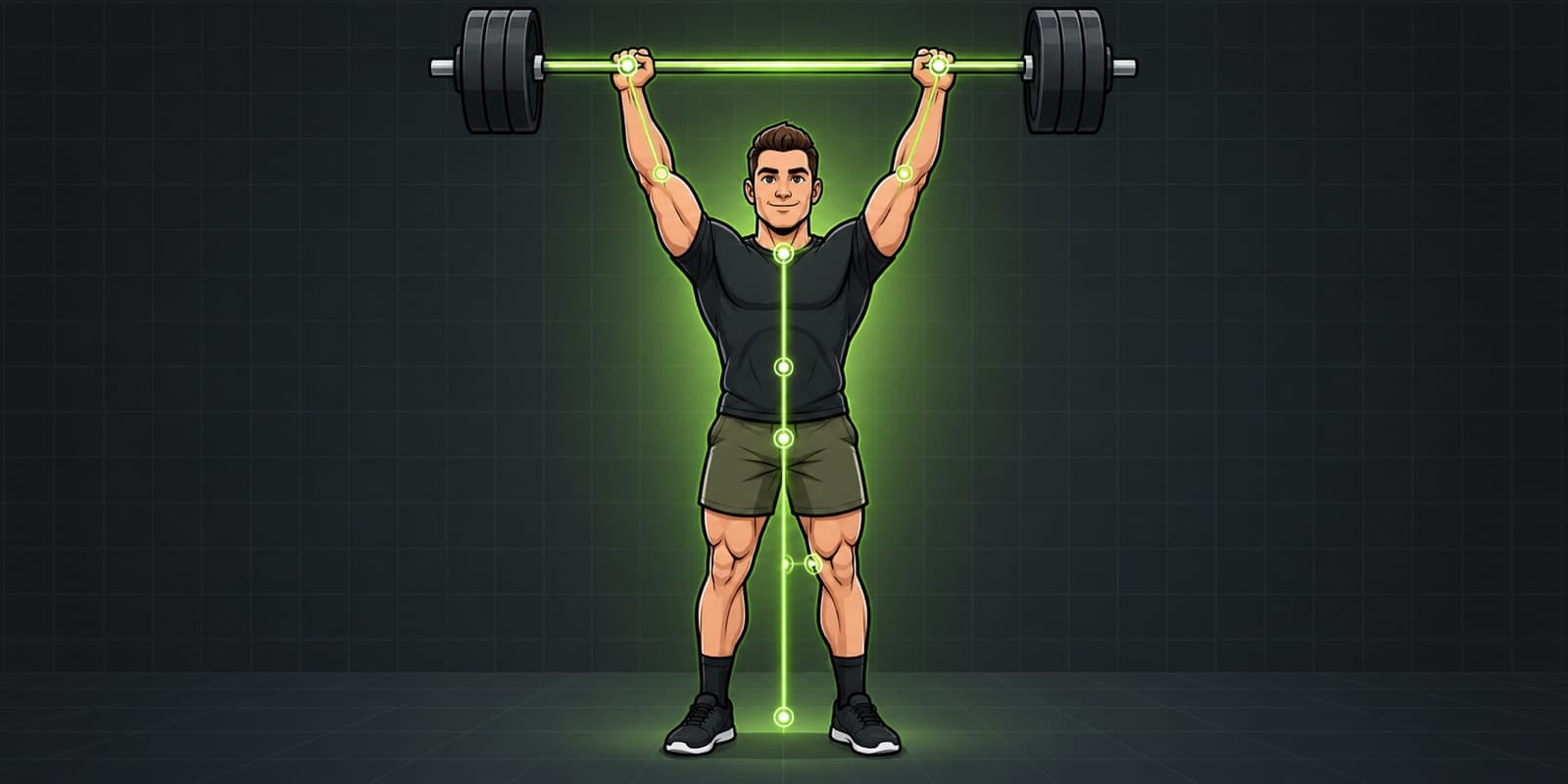
Pressing a bar from the shoulders to overhead is the oldest test of upper body strength, and it remains one of the best. It builds the deltoids and triceps, trains the upper back and trunk to stabilise a load over the body, and demands a level of shoulder and thoracic mobility that the bench press lets you avoid. Most people press badly for two reasons: they lean back and use their legs, or they never learned to move their head. Both are fixable.
What the overhead press trains
The press is shoulder flexion and abduction with elbow extension. The deltoids, all three heads but especially the anterior and lateral, do the pressing; the triceps finish the lockout; the upper traps and serratus rotate the shoulder blades upward to make room; the trunk, glutes and legs hold the body rigid under the load. Standing barbell pressing produces higher deltoid and trunk activation than seated or machine versions (Saeterbakken and Fimland 2013), which is why it belongs in the main-lift slot.
Setup
Rack height. Set the bar at about upper chest height, so you can unrack it by extending the legs slightly without pressing it out of the rack.
Grip. Just outside shoulder width, so that the forearms are vertical when the bar is on the shoulders. Wider than that shortens the range but reduces triceps involvement and stresses the shoulders; narrower puts the elbows in front of the bar excessively. Full grip, thumb around the bar. The bar sits on the heel of the palm, over the forearm bones, with the wrist only slightly extended.
Rack position. The bar rests on the front of the shoulders, or just above them, touching the upper chest. The elbows are slightly in front of the bar, not directly under it and not far in front as in a front squat. Lift the chest to create a shelf. If the bar cannot reach the shoulders because of tight lats or wrists, the mobility section below is for you.
Unrack. Take a breath, extend the legs slightly to lift the bar off the hooks, and step back two short steps. Feet about hip to shoulder width, toes slightly out.
Body. Squeeze the glutes hard, brace the abdominals, and keep the ribs down. This is the position you hold for the entire set. The glute squeeze prevents the lower back from arching; the brace transmits force. The knees stay straight; there is no leg drive in a strict press.
Eyes. Fix on a point straight ahead or slightly up.
The press
- Take a deep breath and brace. Squeeze the glutes.
- Tilt the head back slightly, just enough for the bar to pass the face. The chin tucks toward the throat; the torso does not lean.
- Press the bar straight up. The bar path is close to vertical; it travels around the face because the head moved, not because the bar swung forward.
- As the bar passes the forehead, push the head forward and through, under the bar, returning the torso to upright. The head moving through is what brings the bar back over the mid-foot.
- Finish with the arms locked, the bar directly over the shoulder joint and the middle of the foot, and the shoulder blades shrugged up toward the ears. That shrug at the top is a full range of motion for the shoulder girdle and is part of the lift.
- Lower under control, moving the head back to let the bar pass the face, to the shoulders. Re-brace and repeat.
Exhale at the top or as the bar passes the sticking point.
Bar path and the head
Watch a beginner press and the bar swings forward in an arc around a stationary head, ending in front of the body where the triceps have to save it. Watch an experienced presser and the bar goes almost straight up while the head bobs back and then forward under it.
The bar wants to travel in a straight vertical line over the mid-foot, because that is the balance point. Your face is in the way. The solution is to move the face, twice: back on the way up until the bar clears it, then forward once it has. The elbows stay slightly in front of the bar until the bar passes the head, then rotate under it for the lockout.
Mobility requirements
The press is often limited not by strength but by the ability to get into the positions. Three checks:
Overhead reach. Stand with your back to a wall, heels a few centimetres from it, lower back flat against it. Raise straight arms overhead. If the arms reach the wall without the ribs flaring or the lower back arching, you have enough shoulder flexion and thoracic extension. If not, the lockout will be compensated with a back arch under load.
Rack position. If the bar cannot rest on the shoulders with a full grip and near-vertical forearms, the lats, triceps or wrists are tight.
Fixes. Lat stretches (hanging from a bar, or arms overhead on a bench with a dowel), thoracic extension over a foam roller, wrist extension stretches, and, above all, pressing itself through the fullest range you can manage with a light weight. Landmine presses and neutral-grip dumbbell presses allow overhead work while the mobility improves. See Stretching and Mobility.
Common faults and fixes
| Fault | Cause | Fix |
|---|---|---|
| Leaning back excessively | Trying to clear the face by moving the torso; lack of overhead mobility; too heavy | Squeeze glutes, brace, ribs down; move the head not the torso; reduce load; mobility work |
| Bar drifts forward | Head not moving back; elbows too far forward | Chin tuck; cue "press to the back of the room"; elbows slightly in front of the bar only |
| Head not through at lockout | Never learned it | Cue "push the head through the window"; finish with ears in line with arms |
| Leg drive | Cheating a heavy weight | Strict press with locked knees; use the push press as a separate exercise |
| Elbows flared out to the sides at the bottom | Wide grip or dumbbell habit | Narrow the grip so forearms are vertical; elbows slightly forward and under |
| Wrist bent back | Bar in the fingers | Bar on the heel of the palm over the forearm bones; wrist wraps if needed |
| Bar stops short at the sticking point (forehead) | Weak triceps and lateral delt at that angle | Pin presses from forehead height; close-grip bench; more pressing volume |
Seated vs standing, barbell vs dumbbell
Standing barbell. Highest trunk and deltoid activation, best transfer, most weight for most people. The main lift.
Seated barbell. Removes the trunk, lets you push the shoulders harder. Fine as a hypertrophy tool; make sure the seat back does not force a big arch.
Standing dumbbells. Lower total load, but a greater range, independent arms and a neutral or angled grip option that many shoulders prefer. Slightly higher deltoid EMG than the seated version.
Seated dumbbells. The classic hypertrophy accessory: stable, high volume, deep range. Muscle activation of the deltoids is very similar to the barbell in most comparisons (Saeterbakken and Fimland 2013).
Landmine press. The bar pressed at an angle from a pivot on the floor. Shoulder-friendly, trainable with limited mobility, and useful for athletes.
Push press. Dip and drive with the legs to launch the bar, then press. A power exercise with 20 to 30 percent more load. Not a substitute for the strict press.
A sensible structure: strict standing barbell press as the main lift, seated or standing dumbbells as the second pressing movement, and lateral raises and rear-delt work to round out the shoulders. See Best Shoulder Exercises.
Programming
- Beginners: 3 sets of 5, twice a week, adding 1 to 1.25 kg per session. The press stalls sooner than any other lift; small plates and patience are required.
- Hypertrophy: 3 to 4 sets of 6 to 10, once or twice a week, plus dumbbell pressing and raises.
- Strength: 3 to 5 sets of 2 to 5 at 80 to 90 percent, with pin presses or push presses as assistance.
- Balance: pair overhead pressing with vertical pulling (pull-ups, pulldowns) and face pulls in similar volume to keep the shoulders balanced. See Pull-Ups from Zero.
- Expectations: a strict press of 60 to 70 percent of your bench press is normal. Progress is measured in kilos per month.
The bottom line
Grip just outside shoulder width with vertical forearms, bar on the front of the shoulders with elbows slightly ahead of it, glutes squeezed and trunk braced. Tilt the head back, press straight up, push the head through as the bar passes the forehead, and lock out with the bar over the mid-foot and the shoulders shrugged. No leg drive, no lean. Fix mobility if the lockout arches the back, use small plates, and give it time; the press is slow to build and worth building.
Sources
- Saeterbakken AH, Fimland MS. "Effects of body position and loading modality on muscle activity and strength in shoulder presses." Journal of Strength and Conditioning Research, 2013.
- Kroell J, Mike J. "Exploring the standing barbell overhead press." Strength and Conditioning Journal, 2017.
- Waller M, Piper T, Miller J. "Overhead pressing power/strength movements." Strength and Conditioning Journal, 2009.
- Schoenfeld BJ, Contreras B, Tiryaki-Sonmez G, Wilson JM, Kolber MJ, Peterson MD. "Regional differences in muscle activation during hamstrings exercise." Journal of Strength and Conditioning Research, 2015.
Frequently asked questions
Is the standing or seated overhead press better?
Standing uses more trunk and stabiliser muscle and transfers better to sport and daily life; seated lets you lift more and isolates the shoulders. EMG research finds standing barbell pressing produces higher deltoid and trunk activation than seated. Use standing as the main lift and seated dumbbell pressing as a hypertrophy accessory.
Should I lean back when overhead pressing?
Only slightly, from a braced trunk, to clear the face on the way up. Excessive leaning turns the press into an incline press, loads the lower back and is the most common way people cheat the lift. Squeeze the glutes, brace the abs, and move the head rather than the torso.
Why is my overhead press so weak compared to my bench?
It always will be; a press of 60 to 70 percent of your bench is normal. The overhead press uses less muscle, has a longer range, and depends on shoulder and thoracic mobility. Progress is slower and comes in smaller increments; use 1 to 1.25 kg plates.
What mobility do I need to overhead press?
Enough shoulder flexion and thoracic extension to put a straight arm directly overhead with the ribs down, and enough wrist and lat flexibility to rack the bar on the shoulders. If you cannot reach a straight arm overhead without arching the lower back, work on lat and thoracic mobility and use landmine or neutral-grip dumbbell presses meanwhile.
Where should the bar finish at lockout?
Directly over the middle of the foot and the shoulder joint, with the head pushed through so the ears are level with or slightly in front of the arms, the elbows locked and the shoulder blades shrugged up. A bar finishing in front of the head is a sign the head did not move through.
Can I use the push press instead?
The push press adds a leg drive and lets you handle more weight and train power; it is a different exercise. For building the shoulders, the strict press is better. Treat the push press as a separate movement, not as a way to add weight to your strict press.