Zone 2 Training: The Complete Guide
10 min read · September 2026 · by Manikanta Sirumalla

For about twenty years, "cardio" in gym culture meant either the fat-burning zone on a treadmill sticker or a HIIT session that left you on the floor. Zone 2 is the thing endurance athletes were doing the whole time, and it has finally reached everyone else. It is easy, it is boring, and it is the highest-return cardio most people can do. This guide explains why, and how to do it right.
What Zone 2 is
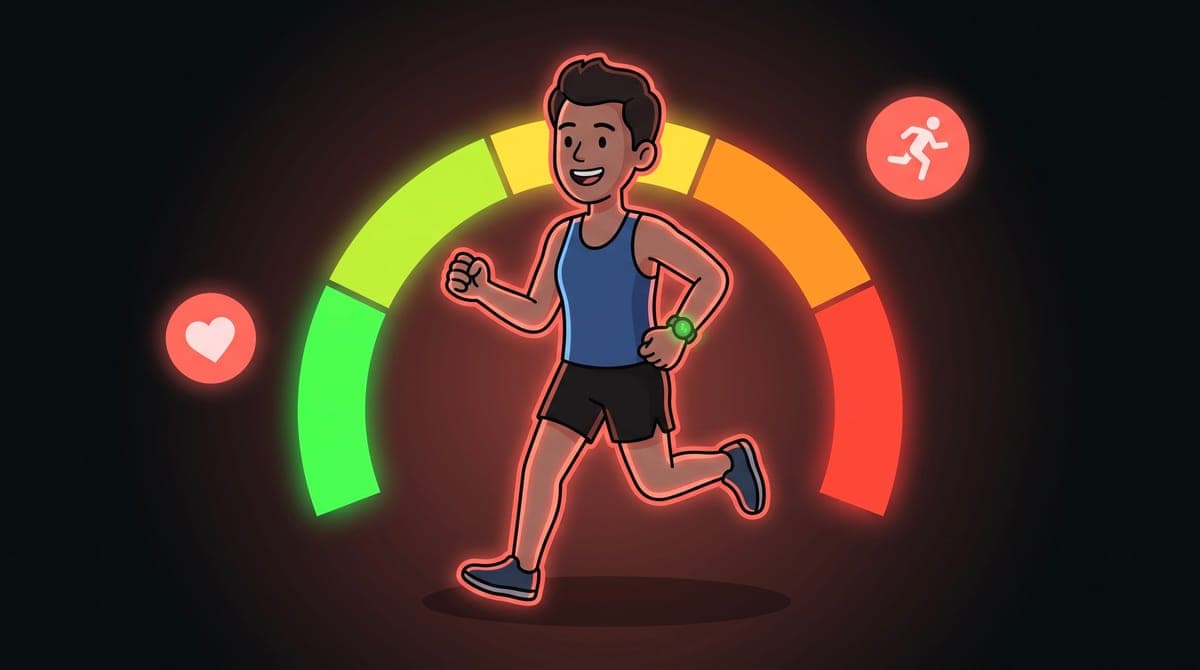
Training zones divide effort into bands by intensity. In the five-zone model used by most coaches and watches, Zone 1 is very easy recovery, Zone 2 is easy aerobic, Zone 3 is moderate, Zone 4 is threshold, and Zone 5 is maximal. See Heart-Rate Zones and Your Real HRmax for the full model.
Physiologically, Zone 2 is the highest intensity at which your body still clears lactate as fast as it produces it. Below that point, your muscles run mainly on fat and on lactate that is shuttled between fibres and burned as fuel. Above it, lactate begins to accumulate, carbohydrate takes over as the main fuel, and the session becomes something else. Exercise physiologists call this boundary the first lactate threshold (LT1) or the aerobic threshold. In a lab it typically corresponds to a blood lactate of around 1.7 to 2 mmol/L (San-Millán and Brooks 2018).
In practice: you can hold a conversation, you are breathing noticeably but not hard, and you could keep going for a long time.
What it does to you
Mitochondria. Mitochondria are the structures inside muscle cells that turn fat and carbohydrate into ATP. Zone 2 recruits mostly slow-twitch (type I) fibres, which are packed with mitochondria, and long sessions at this intensity are the strongest stimulus for growing more of them and making them work better. More mitochondrial density means more fat oxidised at any given pace, more lactate cleared, and more headroom before fatigue.
Metabolic flexibility. People with high mitochondrial function switch smoothly between fat and carbohydrate as fuel. Those with poor function, which includes many sedentary adults and people with insulin resistance, burn carbohydrate even at rest and accumulate lactate at low intensities. San-Millán and Brooks showed that fat oxidation capacity during Zone 2 exercise tracks closely with metabolic health and insulin sensitivity, and improves with training (San-Millán and Brooks 2018).
Cardiac output. Steady aerobic work increases stroke volume, the amount of blood the heart pumps per beat. Over months, resting heart rate falls and your heart does the same work with fewer beats. See Resting Heart Rate.
Capillaries and oxygen delivery. More capillaries grow around trained fibres, improving oxygen and nutrient delivery and waste removal. This also helps recovery between lifting sets and sessions.
Recovery. Because Zone 2 does not generate much muscle damage or nervous-system fatigue, it can be repeated often and even used as active recovery on lifting rest days.
VO2 max. Zone 2 is not the fastest way to raise VO2 max (intervals are), but it builds the aerobic base that intervals sit on, and in less-trained people it raises VO2 max substantially on its own. See VO2 Max: Why It Predicts Longevity.
Why elite endurance athletes do so much of it
Analyses of training in elite runners, cyclists, rowers and cross-country skiers consistently find the same pattern: about 75 to 80 percent of training time at low intensity (Zones 1 and 2), very little in the middle, and 15 to 20 percent hard (Seiler 2010). This "polarized" or "pyramidal" distribution beat "threshold" training, which spends a lot of time in the moderately hard middle, in controlled comparisons (Stöggl and Sperlich 2014).
The lesson for recreational people is not to train like an elite. It is that easy work is not junk. The base of aerobic fitness is built at an intensity that feels almost too easy, and the common mistake is to make every session moderately hard, which is too hard to recover from daily and too easy to drive top-end adaptations.
Finding your Zone 2
The talk test. The simplest and, honestly, one of the best. You should be able to speak in full sentences with slight effort. If you can only manage a few words at a time, you are in Zone 3 or above. If you can sing, you are in Zone 1. The point at which speech becomes uncomfortable tracks the first lactate threshold closely.
Heart rate, approximately. Zone 2 is around 60 to 70 percent of your true maximum heart rate. The problem is that "220 minus age" mis-estimates max heart rate by 10 to 20 beats in many people, so a Zone 2 built on it can be Zone 1 or Zone 3. If you have a measured or field-tested maximum, use it. If you know your lactate threshold heart rate from a hard 30-minute effort, Zone 2 is roughly 70 to 80 percent of it. See Heart-Rate Zones and Your Real HRmax for how to test.
Rate of perceived exertion. About 3 to 4 out of 10. Comfortable, sustainable, not lazy.
Lactate meter. The gold standard, used by serious endurance athletes: take finger-prick samples at increasing intensities and find the pace just before lactate rises above about 2 mmol/L. Overkill for most people.
Watch-estimated zones. Watch zones are built from age formulas by default and are frequently wrong. Set your max heart rate manually if you know it, and cross-check with the talk test.
A useful reality check: if your "Zone 2" session leaves you tired, it was not Zone 2. Most people, especially lifters, do it too hard.
How much you need
The mitochondrial stimulus builds with duration within a session. Sessions under 30 minutes do relatively little; 45 to 60 minutes is where the benefits accumulate, and endurance athletes go longer.
For general health and a real aerobic base:
- Minimum effective: 2 sessions of 45 minutes per week (90 minutes).
- Good: 3 to 4 sessions of 45 to 60 minutes (150 to 240 minutes). This aligns with the 150 minutes of moderate activity in public-health guidelines, which is the range associated with large reductions in cardiovascular and all-cause mortality.
- Endurance performance: 5 hours or more, with hard intervals on top.
If you can only do one aerobic thing, this is it. If you can do two, add one interval session per week for VO2 max.
What to do it on
Any activity that raises heart rate steadily for 45 minutes works. The best choice depends on joints, goals and how it interacts with lifting:
- Incline walking. Low impact, easy to keep in zone, minimal interference with lifting. Excellent for most people. See Walking for Fat Loss.
- Cycling. Low impact, precise control of intensity, and the modality with the least interference with strength gains in the concurrent-training research.
- Rowing and elliptical. Full-body, low impact, good for people who find walking too easy and running too hard on the joints.
- Running. Effective but higher impact and higher interference with leg strength; many people also struggle to run slowly enough to stay in zone.
- Swimming. Great for joints, harder to monitor heart rate.
Adaptations are local to the muscles used, so cyclists build cycling mitochondria and runners build running mitochondria. Cross-training still benefits the heart and metabolism.
Fitting it around lifting
The concern that cardio "kills gains" is mostly about high-intensity or high-volume endurance work, and mostly about running. Meta-analyses of concurrent training find that easy aerobic work, particularly cycling, has little effect on muscle growth or strength when total volume is moderate, and interference grows with intensity, volume and proximity to the lifting session (Wilson et al. 2012; Schumann et al. 2022). See How Much Cardio While Building Muscle.
Practical rules:
- Keep Zone 2 truly easy. The stimulus that interferes with lifting is hard cardio, not easy cardio.
- Separate lifting and cardio by at least 3 to 6 hours, or put them on different days, when possible.
- If they must share a session, lift first.
- Favour cycling or incline walking over running during a muscle-building phase.
- Count the calories. Three hours of Zone 2 can burn 1,500 to 2,000 kcal a week, which matters in a bulk.
Common mistakes
- Going too hard. The most common error by far. Zone 3 feels productive and is a recovery tax with a weaker mitochondrial return.
- Too short. Fifteen minutes on the bike after lifting is fine as a cooldown but is not a Zone 2 session.
- Trusting the watch's default zones. Set your real maximum or use the talk test.
- Doing only Zone 2. After the first few months, one weekly interval session adds the VO2 max stimulus Zone 2 cannot provide.
- Skipping the strength work. Zone 2 does not build muscle. Both matter for longevity. See Strength Training for Longevity.
The bottom line
Zone 2 is easy, conversational cardio just below the point where lactate accumulates. It grows mitochondria, improves fat oxidation and metabolic health, lowers resting heart rate and builds the aerobic base everything else sits on. Find it with the talk test or a real max heart rate, do 150 to 180 minutes a week in sessions of 45 minutes or more, choose a low-impact modality if you lift, and keep it honest: if it feels hard, it is not Zone 2.
Sources
- San-Millán I, Brooks GA. "Assessment of Metabolic Flexibility by Means of Measuring Blood Lactate, Fat, and Carbohydrate Oxidation Responses to Exercise in Professional Endurance Athletes and Less-Fit Individuals." Sports Medicine, 2018.
- Seiler S. "What is best practice for training intensity and duration distribution in endurance athletes?" International Journal of Sports Physiology and Performance, 2010.
- Stöggl T, Sperlich B. "Polarized training has greater impact on key endurance variables than threshold, high intensity, or high volume training." Frontiers in Physiology, 2014.
- Wilson JM, Marin PJ, Rhea MR, et al. "Concurrent training: a meta-analysis examining interference of aerobic and resistance exercises." Journal of Strength and Conditioning Research, 2012.
- Schumann M, Feuerbacher JF, Sünkeler M, et al. "Compatibility of Concurrent Aerobic and Strength Training for Skeletal Muscle Size and Function: An Updated Systematic Review and Meta-Analysis." Sports Medicine, 2022.
Frequently asked questions
What heart rate is Zone 2?
Roughly 60 to 70 percent of your true maximum heart rate, or about 70 to 80 percent of your lactate threshold heart rate. The formula 220 minus age is unreliable for individuals, so the talk test is a better guide: you should be able to speak in full sentences but not sing. If a lab is available, Zone 2 sits just below the first lactate threshold, around 1.7 to 2 mmol/L.
How much Zone 2 per week do I need?
For general health and a solid aerobic base, 150 to 180 minutes per week split into sessions of 45 to 60 minutes. Endurance athletes do far more. Below about 30 minutes per session the mitochondrial stimulus is small, so fewer, longer sessions beat many short ones.
Does Zone 2 burn fat?
It burns the highest proportion of fat as fuel of any intensity, and it trains your mitochondria to oxidise fat better over time. But total calories burned per minute are modest, and fat loss is determined by your overall calorie deficit, not the fuel used during a session.
Is walking Zone 2?
For many people, brisk walking, especially uphill or with a weighted vest, reaches Zone 2. For fit people, walking on the flat is Zone 1. Check by heart rate or the talk test rather than by activity.
Will Zone 2 cardio hurt my strength gains?
Very little, if it is truly easy and separated from lifting by a few hours or a day. The interference effect is driven by high-intensity or high-volume endurance work, especially running. Cycling or incline walking in Zone 2 is the most lifting-friendly option.
Can I do Zone 2 on a bike or rower instead of running?
Yes. Any modality that raises heart rate steadily works. Cycling, rowing, incline walking, elliptical and swimming all count. The mitochondrial adaptations are largest in the muscles doing the work, so pick the one that suits your goals and joints.