How Much Protein Do You Actually Need Per Day?
9 min read · September 2026 · by Manikanta Sirumalla

Protein is the one macronutrient almost everyone agrees matters, and the one whose recommended amount varies by a factor of three depending on who you ask. Government guidelines say 0.8 grams per kilogram of body weight. Gym culture says a gram per pound, or 2.2 g/kg. The research says both are answers to different questions. This article sets your number from the evidence, then shows you how to actually hit it.
Why the RDA is the wrong number for you
The Recommended Dietary Allowance of 0.8 g/kg per day is the minimum intake that prevents deficiency in nearly all sedentary adults. It was never designed to optimise anything. It is the floor below which you lose nitrogen balance, not the level at which you build the most muscle, recover fastest from training, or preserve the most lean mass on a diet.
Resistance training raises protein needs for a simple reason: it breaks down muscle protein and stimulates the machinery that rebuilds it, and rebuilding requires amino acids. Reviews of the research in athletes have consistently landed on a range of roughly 1.4 to 2.0 g/kg per day (Jäger et al. 2017; Phillips and Van Loon 2011).
The number that matters: 1.6 g/kg
The most useful single study is a 2018 meta-analysis by Morton and colleagues that pooled 49 randomised trials with nearly 1,900 participants who lifted weights while eating different amounts of protein. Adding protein increased strength and lean mass gains, but the effect plateaued at about 1.62 g/kg per day. Above that, more protein produced no further measurable gain in muscle (Morton et al. 2018).
The confidence interval on that breakpoint ran up to about 2.2 g/kg, which is why many coaches recommend the range 1.6 to 2.2 g/kg. The lower end captures essentially all the benefit for the average lifter. The upper end costs nothing but calories and covers people who respond better to more.
For a 70 kg person, that is 112 to 154 g per day. For a 90 kg person, 144 to 198 g.
Adjusting for your goal
Building muscle in a surplus. 1.6 to 2.2 g/kg. Since you are eating plenty of calories, there is no reason to push higher, and carbohydrate will do more for your training. See The Lean Bulk Guide.
Losing fat in a deficit. This is where protein needs go up, not down. In a deficit the body is looking for energy, and muscle protein is a candidate. Higher protein reduces that loss, increases fullness more than any other macronutrient, and has the highest thermic effect of feeding (about 20 to 30 percent of its calories are burned digesting it). A systematic review in lean, resistance-trained athletes concluded that 2.3 to 3.1 g per kilogram of lean body mass was needed to preserve muscle during hard dieting (Helms et al. 2014). For most people, 1.8 to 2.4 g/kg of body weight covers it. See The Cutting Guide.
Body recomposition. Losing fat and gaining muscle at once is most feasible for beginners and people returning from a layoff, and it is protein-dependent. Aim for the top of the range, around 2.0 to 2.4 g/kg. See Body Recomposition.
General health without training. Even here, 0.8 g/kg is low for adults over 40. Higher intakes of around 1.0 to 1.2 g/kg help maintain muscle with age, and the elderly show a blunted response to protein that is best overcome with larger doses per meal (Phillips and Van Loon 2011).
If you carry a lot of body fat
Setting protein on total body weight over-shoots for people at high body fat, because fat tissue does not need much protein to maintain. If your body fat is above roughly 30 percent, use one of these instead:
- Lean mass. Estimate body fat, subtract it, and set protein at 2.0 to 2.4 g per kilogram of what remains. See Fat-Free Mass and Body Fat Percentage.
- Goal weight. Set protein at 1.6 to 2.0 g per kilogram of the weight you are working toward. Simpler, and nearly equivalent.
Is too much protein dangerous?
The concern is usually the kidneys. In healthy adults, it is not supported. A 2018 meta-analysis of trials comparing higher-protein diets against normal ones found no negative effect on kidney function (Devries et al. 2018). Studies feeding trained people 3 to 4 g/kg for months found no changes in kidney or liver markers or blood lipids (Antonio et al. 2016). Bone health, once thought to suffer from protein, actually benefits from higher intake when calcium is adequate.
The real limit is not toxicity. It is opportunity cost. Every calorie spent on protein above your need is a calorie not spent on carbohydrate, which fuels training, or fat, which supports hormones. For people with existing kidney disease the picture is different, and they should follow medical advice.
Per meal: the "30 gram" myth and what replaces it
You have probably heard that the body can only absorb 20 to 30 g of protein in one sitting. Absorption is not the issue; the gut absorbs nearly all of it. What has a ceiling is the muscle-building response to a single meal, which rises steeply and then plateaus at around 0.4 g/kg, or about 30 to 40 g for most adults (Schoenfeld and Aragon 2018). Protein above that in a single meal is not wasted, it is used for other things, but it does not add much extra muscle stimulus.
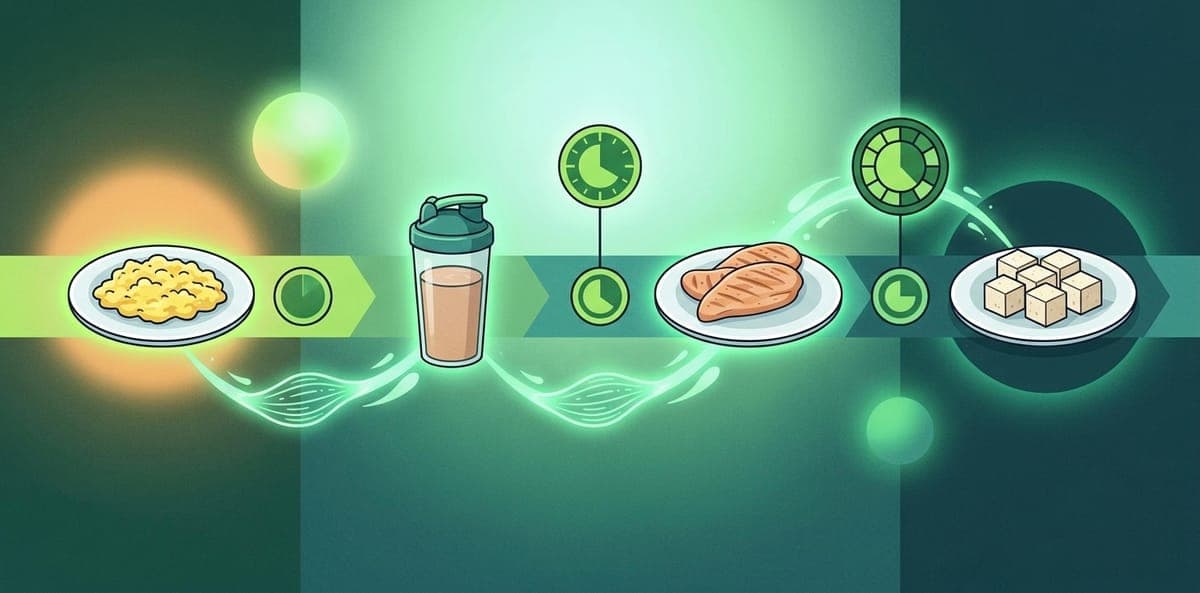
The practical consequence: spread your daily total across three to five meals of 25 to 40 g each, spaced three to five hours apart. This beats the same total eaten in one or two large meals, and matters more the closer you are to your minimum. A dose of 30 to 40 g before bed, ideally slow-digesting casein, adds a fifth feeding across the overnight fast. See Protein Timing for the details.
Quality matters a little
Animal proteins (meat, fish, eggs, dairy) and soy are "complete," meaning they carry all essential amino acids in the amounts muscle needs, and they are rich in leucine, the amino acid that switches on muscle protein synthesis. Most single plant proteins are lower in one or more amino acids, and lower in leucine.
Plant-based lifters can match animal-protein results by eating slightly more total protein (toward 2.0 g/kg), combining sources (rice and pea, beans and grains) and using soy or blended plant powders (Pinckaers et al. 2021). See Protein Powder: Whey vs. Casein vs. Plant.
Hitting your number in real food
A 150 g target sounds like a lot until you break it into meals:
| Food | Portion | Protein |
|---|---|---|
| Chicken breast, cooked | 150 g | 45 g |
| Greek yoghurt, 0% | 200 g | 20 g |
| Eggs | 3 large | 19 g |
| Whey protein | 1 scoop (30 g) | 24 g |
| Tofu, firm | 200 g | 24 g |
| Lentils, cooked | 200 g | 18 g |
| Cottage cheese | 200 g | 22 g |
| Salmon, cooked | 150 g | 33 g |
Four meals built around one of these, plus a shake if a meal falls short, gets almost anyone to 1.6 g/kg without tracking every gram. A powder is a convenience, not a requirement; it earns its place when a meal would otherwise be short. See the Macro Calculator to build your full targets around your protein number.
The bottom line
Set protein at 1.6 to 2.2 g per kilogram of body weight if you train, the higher end and up to 2.4 g/kg if you are dieting, and use lean mass or goal weight if you carry a lot of fat. Spread it over three to five meals of 25 to 40 g. Do not worry about kidney damage unless you already have kidney disease. And remember protein is only the material; progressive overload in the gym is the instruction to build with it.
Sources
- Morton RW, Murphy KT, McKellar SR, et al. "A systematic review, meta-analysis and meta-regression of the effect of protein supplementation on resistance training-induced gains in muscle mass and strength in healthy adults." British Journal of Sports Medicine, 2018.
- Jäger R, Kerksick CM, Campbell BI, et al. "International Society of Sports Nutrition position stand: protein and exercise." Journal of the International Society of Sports Nutrition, 2017.
- Phillips SM, Van Loon LJC. "Dietary protein for athletes: from requirements to optimum adaptation." Journal of Sports Sciences, 2011.
- Helms ER, Zinn C, Rowlands DS, Brown SR. "A systematic review of dietary protein during caloric restriction in resistance trained lean athletes: a case for higher intakes." International Journal of Sport Nutrition and Exercise Metabolism, 2014.
- Schoenfeld BJ, Aragon AA. "How much protein can the body use in a single meal for muscle-building? Implications for daily protein distribution." Journal of the International Society of Sports Nutrition, 2018.
- Devries MC, Sithamparapillai A, Brimble KS, et al. "Changes in kidney function do not differ between healthy adults consuming higher- compared with lower- or normal-protein diets: a systematic review and meta-analysis." Journal of Nutrition, 2018.
- Antonio J, Ellerbroek A, Silver T, et al. "A high protein diet has no harmful effects: a one-year crossover study in resistance-trained males." Journal of Nutrition and Metabolism, 2016.
- Pinckaers PJM, Trommelen J, Snijders T, van Loon LJC. "The anabolic response to plant-based protein ingestion." Sports Medicine, 2021.
Frequently asked questions
How much protein do I need to build muscle?
Around 1.6 g per kilogram of body weight per day. A 2018 meta-analysis of 49 trials found gains in lean mass plateau at about that intake. Eating up to 2.2 g/kg provides a small safety margin at no cost beyond calories.
How much protein should I eat to lose fat?
More than for building: about 1.8 to 2.4 g/kg. In a calorie deficit, higher protein preserves muscle, keeps you fuller, and has a higher thermic cost. Very lean people cutting to low body fat may go up to about 2.3 to 3.1 g per kilogram of lean mass.
Is 1 gram per pound of body weight necessary?
It is 2.2 g/kg, the upper end of the useful range. It is not harmful and works as a simple rule, but the evidence shows little extra benefit above 1.6 g/kg for muscle gain. It becomes more useful in a hard cut.
Can you eat too much protein?
In healthy adults, intakes up to about 3 g/kg have shown no kidney, liver or bone harm in controlled trials. The practical cost is that calories spent on protein above your need are calories not spent on carbohydrate and fat that fuel training and hormones.
Do women need less protein?
No. The per-kilogram recommendations are identical. Women weigh less on average, so absolute grams are lower, but the ratio to body weight does not change, and the muscle-preserving benefit in a deficit applies equally.
How much protein can the body absorb in one meal?
The old 20 to 30 g ceiling is a myth about absorption; the body absorbs almost all of it. What plateaus is the muscle-building response per meal, at roughly 0.4 g/kg (about 30 to 40 g for most people). Larger meals are not wasted, they just do not add much extra stimulus, so spreading protein across 3 to 5 meals is the practical optimum.