Muscle Soreness (DOMS): What It Means and What Actually Helps
8 min read · September 2026 · by Manikanta Sirumalla
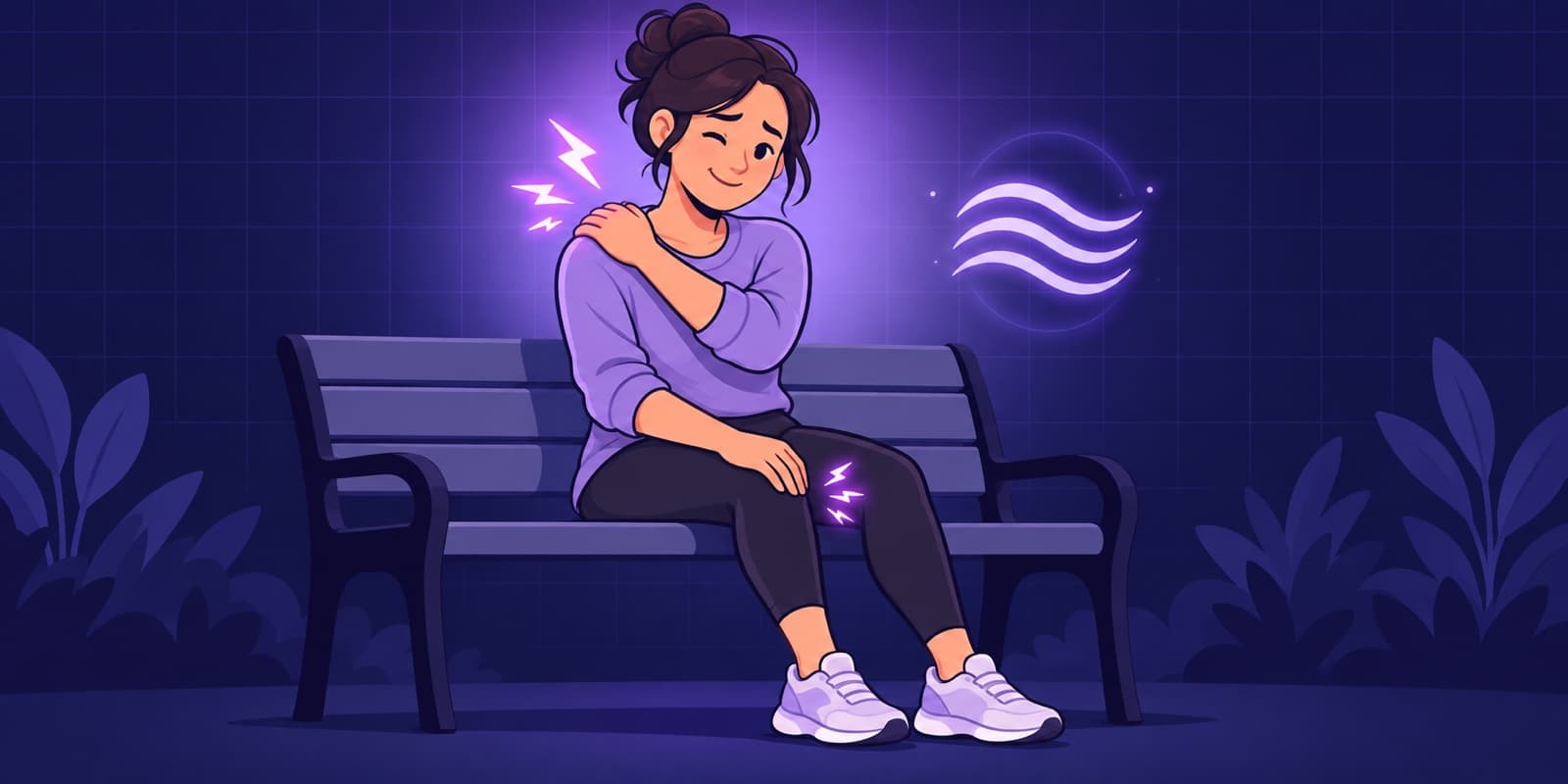
You trained on Monday, felt fine on Monday night, and woke up Wednesday unable to sit down without bracing on the sink. This is delayed onset muscle soreness, DOMS, and it is one of the most misunderstood things in fitness. It gets blamed on lactic acid, sold as proof of a good session, and treated with stretches that do nothing. Here is what the physiology actually says.
What DOMS is
DOMS is soreness, stiffness and tenderness in a muscle that appears 12 to 24 hours after exercise, peaks at 24 to 72 hours, and resolves within about five to seven days. It follows exercise that is unfamiliar or that involves a lot of eccentric loading: the lowering phase of a lift, downhill running, the landing in a jump.
The mechanism is mechanical and inflammatory. Eccentric contractions, where the muscle produces force while lengthening, cause microscopic damage to muscle fibres, to the structures that hold them together, and to the surrounding connective tissue. The body responds with an inflammatory repair process: fluid moves into the tissue, immune cells arrive, and nerve endings become sensitised by inflammatory chemicals. That sensitisation is what you feel as soreness, and because the inflammatory response builds over a day or two, so does the pain (Cheung et al. 2003).
Muscle fibres themselves have no pain receptors, which is why you do not feel the damage as it happens; you feel the inflammation that follows.
What DOMS is not
Not lactic acid. Lactate produced during exercise is cleared within an hour and is used as fuel. It has no role in next-day soreness. This was demonstrated in the 1980s and has been repeated many times since. The persistence of the myth is impressive.
Not a measure of a good workout. Soreness tracks how novel and eccentric the exercise was, not how effective it was for building muscle. A beginner doing three sets of goblet squats can barely walk for three days; an experienced lifter squatting twice their body weight may feel nothing. The second session was a vastly better muscle-building stimulus. Research directly comparing training that causes lots of damage with training that causes little finds no advantage for the damaging version in muscle growth (Flann et al. 2011; Damas et al. 2016). If anything, excessive damage diverts resources to repair rather than growth.
Not an injury. DOMS is diffuse, symmetrical across the muscles worked, and improves with movement. An injury is usually sharp, localised, present during the session, and gets worse with movement.
The repeated bout effect
The most useful fact about DOMS: one exposure protects you from the next.
After a single bout of eccentric exercise, the same exercise repeated within weeks produces far less damage and soreness, sometimes almost none, even if the second session is harder. This is the repeated bout effect, and it involves adaptations in the nervous system, in the muscle's connective tissue, and in the fibres themselves (McHugh 2003). The protection lasts for weeks to months and is specific to the movement and muscle.
Practically, this means the terrible soreness of week one of a new program is a one-time tax. It also tells you how to avoid it: introduce new exercises with lower volume in the first session or two, and let the repeated bout effect do its job before you push.
Should you train sore?
Mild to moderate soreness (a bit stiff, tender to touch, full range of motion): train. Working a sore muscle does not delay its recovery or impair growth, and the increased blood flow of light-to-moderate activity typically reduces the soreness for a few hours. Many lifters find that a warm-up set makes the soreness fade for the duration of the session.
Severe soreness (limited range of motion, altered walking, pain that disrupts sleep): wait, or train other muscles. Severe DOMS impairs force production, alters movement patterns, and increases injury risk if you load the affected muscle heavily. Give it a day or two more, do easy cardio or upper body if the legs are the problem, and return when you can move normally.
A structural note: a well-designed program with muscle groups trained two or three times a week deliberately keeps soreness moderate by spreading volume across sessions. If you are routinely crippled after each session, the volume per session is too high. See Training Frequency and Training Volume.
What actually helps
A 2018 meta-analysis pooled 99 studies of recovery interventions and ranked them by their effect on DOMS and on markers of muscle damage and inflammation (Dupuy et al. 2018). The results:
Massage. The most effective single intervention for reducing soreness and inflammatory markers, and for perceived fatigue. Twenty to thirty minutes within a couple of hours of training had the best effect. Self-massage with a foam roller produces a smaller but real benefit (Pearcey et al. 2015).
Active recovery. Light activity such as walking or easy cycling reduces soreness modestly and is free. It also does no harm to adaptation.
Compression garments. Small reduction in soreness and perceived fatigue when worn for hours after exercise.
Cold water immersion. Reduces soreness and inflammatory markers. The catch is that inflammation is part of the growth signal, and trials show routine cold plunging after resistance training reduces long-term muscle and strength gains (Roberts et al. 2015). Use it when you need to perform again soon, not as a routine after lifting. See Sauna, Cold Plunge, and Recovery.
Sleep. Not in the meta-analysis because it is not an intervention people randomise, but the strongest determinant of how fast tissue repairs. See Sleep and Recovery.
Protein. Adequate daily protein supports repair; there is no evidence that extra protein above 1.6 to 2.2 g/kg speeds it further.
Heat. Warm baths and sauna after exercise have some evidence for reduced soreness and do not appear to blunt adaptation.
What does not help
Stretching. A Cochrane review pooling 12 studies concluded that stretching before, after or both had no meaningful effect on muscle soreness (Herbert et al. 2011). Stretch for range of motion if you want it; do not expect it to fix DOMS.
Anti-inflammatory drugs. Ibuprofen and similar reduce soreness modestly but, taken regularly, blunt muscle protein synthesis and the adaptive response, and carry stomach and kidney risks. Reserve them for genuine pain, not routine soreness.
Antioxidant supplements. High-dose vitamin C and E reduce oxidative stress markers and, in several trials, reduce training adaptations along with them. The inflammation you are trying to suppress is part of how muscle grows.
Most recovery supplements. BCAAs, glutamine, tart cherry and curcumin show small or inconsistent effects on soreness and, as with antioxidants, may trade adaptation for comfort. See Supplements That Actually Work.
"Working it out" with the same hard session. Light activity helps; another maximal eccentric session on a badly damaged muscle does not.
Preventing severe DOMS
- Ramp new exercises. Half the planned volume in the first session, three-quarters in the second, full from the third.
- Respect eccentric load. Slow negatives, drop sets and new eccentric-heavy movements are the biggest DOMS triggers. Introduce them gradually. See Eccentric Training.
- Warm up properly. Reduces soreness modestly and reduces injury risk substantially. See How to Warm Up Properly.
- Spread volume across the week. Two or three moderate sessions per muscle beat one huge one.
- Sleep and eat. Recovery capacity sets the ceiling.
When soreness is something else
See a clinician if soreness is severe and accompanied by very dark urine, swelling, or weakness that does not improve, which can indicate rhabdomyolysis, a rare but serious breakdown of muscle after extreme unaccustomed exercise. It is uncommon in sensible training and much more common after extreme first sessions such as hundreds of reps of a single exercise. Sharp, localised pain that appeared during a session is a strain, not DOMS, and needs rest and assessment.
The bottom line
DOMS is inflammation from microscopic muscle damage after unfamiliar or eccentric-heavy exercise, not lactic acid, not a badge of a good session, and not a requirement for growth. It fades fast thanks to the repeated bout effect. Train through mild soreness, wait out severe soreness, and use the things with evidence, massage, light movement, sleep and enough protein, rather than stretching and supplements that do nothing.
Sources
- Cheung K, Hume P, Maxwell L. "Delayed onset muscle soreness: treatment strategies and performance factors." Sports Medicine, 2003.
- McHugh MP. "Recent advances in the understanding of the repeated bout effect: the protective effect against muscle damage from a single bout of eccentric exercise." Scandinavian Journal of Medicine and Science in Sports, 2003.
- Flann KL, LaStayo PC, McClain DA, Hazel M, Lindstedt SL. "Muscle damage and muscle remodeling: no pain, no gain?" Journal of Experimental Biology, 2011.
- Damas F, Phillips SM, Libardi CA, et al. "Resistance training-induced changes in integrated myofibrillar protein synthesis are related to hypertrophy only after attenuation of muscle damage." Journal of Physiology, 2016.
- Dupuy O, Douzi W, Theurot D, Bosquet L, Dugué B. "An Evidence-Based Approach for Choosing Post-exercise Recovery Techniques to Reduce Markers of Muscle Damage, Soreness, Fatigue, and Inflammation: A Systematic Review With Meta-Analysis." Frontiers in Physiology, 2018.
- Pearcey GE, Bradbury-Squires DJ, Kawamoto JE, et al. "Foam rolling for delayed-onset muscle soreness and recovery of dynamic performance measures." Journal of Athletic Training, 2015.
- Herbert RD, de Noronha M, Kamper SJ. "Stretching to prevent or reduce muscle soreness after exercise." Cochrane Database of Systematic Reviews, 2011.
- Roberts LA, Raastad T, Markworth JF, et al. "Post-exercise cold water immersion attenuates acute anabolic signalling and long-term adaptations in muscle to strength training." Journal of Physiology, 2015.
Frequently asked questions
Why am I sore two days after working out?
Unfamiliar exercise, especially the lowering (eccentric) phase, causes microscopic damage to muscle fibres and connective tissue. The inflammatory repair response builds over 24 to 48 hours, which is why soreness peaks a day or two later rather than immediately. It usually resolves by day three to five.
Should I work out if I am still sore?
Mild to moderate soreness: yes. Training sore does not impair recovery or growth, and light movement often reduces the soreness. Severe soreness that limits range of motion or alters your movement pattern: train other muscles or do easy activity, and wait a day or two before loading that muscle hard again.
Is soreness a sign of a good workout?
No. Soreness tracks novelty and eccentric load, not the quality of the muscle-building stimulus. Trained lifters make excellent progress with little soreness; beginners are extremely sore from sessions that barely count. Judge a session by the loads and reps you performed, not by how you feel the next day.
Is DOMS caused by lactic acid?
No. Lactate is cleared from muscle within an hour of exercise and has nothing to do with next-day soreness. The lactic acid explanation was disproved decades ago but persists in gym folklore.
What is the fastest way to get rid of DOMS?
Nothing eliminates it, but massage and light active recovery (walking, easy cycling) have the best evidence for reducing it modestly. Sleep and adequate protein support repair. Cold water immersion reduces soreness slightly but may blunt muscle growth if used routinely after lifting. Stretching has no effect.
How do I prevent muscle soreness when starting a new program?
Introduce new exercises or large increases in eccentric load gradually, with lower volume in the first one or two sessions. A single moderate exposure produces the repeated bout effect, which protects against severe soreness from the same exercise for weeks afterward.