Symptom Tracking: Turning Daily Signals Into Training Decisions
8 min read · April 2025 · by Manikanta Sirumalla

You had a terrible session on Thursday. Squats felt impossibly heavy, you cut it short, and you spent the drive home guessing: bad sleep, not enough food, work stress? All plausible. Without a record, that is all it will ever be.
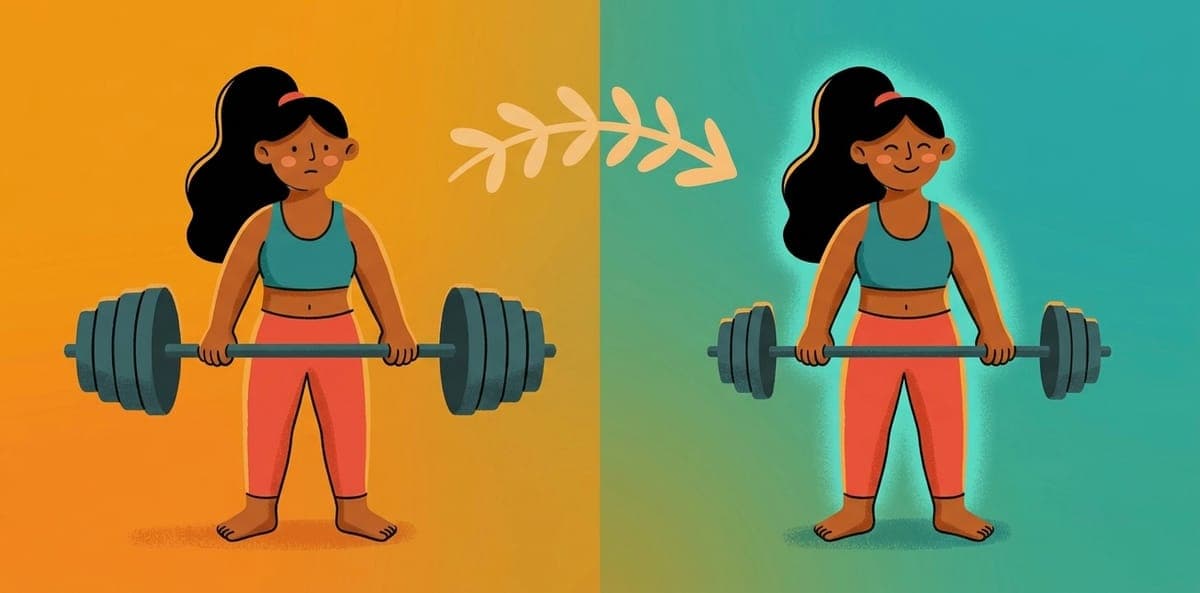
The point of symptom tracking is not self-knowledge for its own sake. It is to train and recover by the symptoms and performance you actually log, rather than by assuming a calendar phase guarantees strength, calories, or recovery. A good log is a decision journal: a small set of daily inputs that resolve into one of three outputs. Add load. Hold. Deload.
The Decision Journal Model
Most tracking fails because it collects data nobody ever uses. Start from the decision and work backwards. There are only three moves in a training week, so you only need enough information to choose between them.
| Today's log | The decision | What it looks like |
|---|---|---|
| Energy at or above baseline, pain none or mild, sleep decent, last session's numbers hit | Add load | Take the planned progression: more weight, an extra rep, or an extra set |
| Mixed signals, one flag but not several | Hold | Run the session as written; repeat last session's numbers rather than pushing |
| Two or more flags, or a rough day that also shows up in performance | Deload the session | Same exercises and loads, roughly a third fewer working sets, one extra rep in reserve |
Note the last row: it deloads a session, not a week. Pre-scheduling a light week onto certain calendar dates is exactly the move the evidence does not support, because cycle phase is a weak predictor of what you can do on a given day (Colenso-Semple et al., 2023). A rough day is a reason to ease that day.
What to Log Daily
Consistency matters more than precision. You are not measuring your physiology; you are producing a signal you can read weeks later. Four inputs carry most of the decision, and two more add useful context.
Energy (1 to 5). Rate it at the same time each day, ideally mid-morning. A 3 is your normal baseline. Take your first instinct rather than deliberating.
Pain (none, mild, moderate, severe). Cramps, lower back pain, headaches, breast tenderness. Note the type if several apply. Pain is the input most likely to change what a session should look like.
Sleep quality (1 to 5). How rested you feel on waking, independent of hours in bed. Seven broken hours are not seven good ones.
Performance (the actual numbers). The load, reps, and reps in reserve you hit on your main lifts, plus a one-line note on how the session felt. This is the input people skip and the one that turns the rest into evidence. A symptom rating with no performance data next to it cannot tell you whether the symptom mattered.
Mood (1 to 5) and bloating or fluid retention (none to severe) round it out. Mood separates a low-energy day from a low-motivation one. Fluid retention is worth logging because it explains scale jumps that are water rather than fat, which stops you reacting to a number that means nothing.
Why Three Cycles Is the Minimum, and What It Is Not
One cycle of data cannot show you a pattern. Cycle length, symptom severity, and timing all move with sleep debt, travel, illness, psychological stress, and training load, so any single cycle can be atypical for reasons that have nothing to do with hormones. Two cycles hint. Three cycles, each with different external circumstances, is where a repeated signal starts to mean something.
Be clear about what you are doing here: pattern hunting, not diagnosis. Finding that your energy tends to dip in the days before your period is a scheduling insight. It is not a medical finding, it does not identify a cause, and it cannot rule anything out. Symptom logs are a tool for planning training, and a starting point for a conversation with a clinician. They are not a substitute for one.
Two more cautions worth holding onto:
- A pattern in your log is still your data, not a rule. Population averages in cycle research are weak; your own average is stronger for you but still an average.
- Absence of a pattern is a real result. Plenty of people find their performance tracks sleep and stress far more than anything cyclical. That is genuinely useful, because it tells you where to spend your attention.
Reading the Log
After three cycles, go looking for three specific things.
Clusters of good days. Where do energy, sleep, and performance all line up? Those are good candidates for your most demanding work: heavy top sets, PR attempts, high-volume sessions. Wherever they land in your cycle is where they land. The rule is train hard when you feel good, not train hard because it is week two.
Clusters of rough days. Where do pain or poor sleep repeatedly coincide with missed reps? That is a stretch where a session-level deload is likely to be the right call. Knowing it in advance means you meet it with a plan instead of a bad session.
Symptoms with no performance consequence. This one is easy to miss and worth chasing. If you consistently rate your energy at 2 on certain days and still hit every prescribed rep, then the feeling is real but it is not costing you training. That is permission to stop pre-emptively cutting sessions you would have completed fine.
Changing One Lever at a Time
When the log says ease off, change one thing. Trim volume by roughly 20 to 30% while keeping the loads, or keep the sets and add a rep in reserve, or swap a high-impact conditioning session for something lower impact. Changing three variables at once tells you nothing about which one helped, which defeats the purpose of keeping a log at all.
Symptoms, Nutrition, and the Scale
Cravings and appetite shifts are common and are worth logging, but a craving entry is not an instruction to add calories on a schedule. Measured changes in resting metabolic rate across the cycle are small and vary considerably between people (Benton et al., 2020), which is why the honest advice is to eat to your targets and honour genuine hunger rather than build a calendar surplus. The luteal phase nutrition guide works through what actually changes.
Bloating data earns its keep by telling you which weigh-ins to discount. If fluid retention reliably peaks in the days before your period, treat those readings as noise rather than as a diet failure.
When the Log Is Telling You to See a Clinician
Symptom tracking is a self-monitoring tool. Some patterns are not training problems, and the right response to them is a medical appointment, not a program change. Talk to a healthcare provider if you notice:
- Periods that stop for three or more consecutive months when you are not pregnant
- A cycle that has become consistently much shorter or longer than it used to be
- Pain that is escalating across cycles, or that stops responding to what previously managed it
- Bleeding heavy enough to disrupt daily life, or new bleeding between periods
- Persistently low mood across the whole cycle rather than in a short window
- Cycle changes alongside chronic fatigue, frequent illness, and stalled training, a combination associated with low energy availability (IOC consensus statement on Relative Energy Deficiency in Sport, 2023)
Bring the log with you. Several months of dated entries give a clinician far more to work with than a recollection, and reported symptom burden is high enough in exercising women that it is worth taking seriously: a study of 6,812 exercising women found symptoms were commonly reported as affecting training availability (Bruinvels et al., 2021).
Keep Reading
- Menstrual cycle and training: the evidence behind the symptom-led approach
- Recovery across your cycle: what sleep and HRV data can and cannot tell you
- Training during your period: symptom-led decisions on the harder days
- Science and evidence: the equations and references behind the numbers we publish
Sources
- Colenso-Semple LM, D'Souza AC, Elliott-Sale KJ, Phillips SM. Current evidence shows no influence of women's menstrual cycle phase on acute strength performance or adaptations to resistance exercise training. Frontiers in Sports and Active Living, 2023.
- McNulty KL, Elliott-Sale KJ, Dolan E, et al. The effects of menstrual cycle phase on exercise performance in eumenorrheic women: a systematic review and meta-analysis. Sports Medicine, 2020.
- Bruinvels G, Goldsmith E, Blagrove R, et al. Prevalence and frequency of menstrual cycle symptoms are associated with availability to train and compete: a study of 6812 exercising women recruited using the Strava exercise app. British Journal of Sports Medicine, 2021.
- Benton MJ, Hutchins AM, Dawes JJ. Effect of menstrual cycle on resting metabolism: a systematic review and meta-analysis. PLOS ONE, 2020.
- Mountjoy M, Ackerman KE, Bailey DM, et al. 2023 International Olympic Committee's (IOC) consensus statement on Relative Energy Deficiency in Sport (REDs). British Journal of Sports Medicine, 2023.
Frequently asked questions
What symptoms should I track for training?
Energy, sleep quality, mood, motivation, muscle soreness, cramps or pain, bloating, appetite and cravings, plus period start and end dates and flow. A quick 1 to 5 rating for each takes under a minute a day.
How long does it take to see a pattern in cycle symptoms?
At least three full cycles. Cycles vary in length and symptoms vary in intensity, so one or two cycles cannot separate a real pattern from coincidence. Consistent daily logging matters more than logging every symptom.
What are common luteal phase symptoms?
Bloating, breast tenderness, cravings, lower energy, poorer sleep, irritability or low mood, and higher perceived effort in training, typically in the last five to seven days before a period. Severity varies enormously between women.
How does symptom tracking help with training?
It shows which days of your cycle you reliably perform well or poorly, lets you plan heavy sessions and deloads around your own pattern, and distinguishes normal fluctuation from signs of overtraining or a medical issue such as iron deficiency.