Recovery Across Your Cycle: Averages, Signals, and What to Program
9 min read · May 2025 · by Manikanta Sirumalla
Training is the stimulus and recovery is where adaptation happens. What is far less settled is the popular next step: that recovery capacity swings so predictably across the cycle that you should schedule hard weeks and easy weeks by the calendar.
Some recovery markers do differ between phases at the group level. Sleep architecture, cardiac vagal activity, and markers of exercise-induced muscle damage have all been studied across the cycle. Those are population averages, measured in modest samples, with wide individual spread. Train and recover by the symptoms and performance you actually log, not by assuming a calendar phase guarantees strength, calories, or recovery.
Sleep: A Real Average, a Weak Prediction
Sleep is the highest-value recovery variable, and it does interact with the cycle. A review of menstrual cycle effects on sleep (Baker and Lee, 2018) describes the pattern most consistently reported: sleep quality tends to be poorer in the late luteal phase, in the days before menstruation, with more reported disturbance, and this is more pronounced in people with significant premenstrual symptoms. The thermogenic effect of progesterone is one plausible contributor, since the drop in core temperature that supports sleep onset is harder to reach from a higher baseline.
Two caveats matter as much as the finding:
- The effect is clearest in self-reported sleep quality, and objective measures across the cycle are less consistent than the popular version of this claim suggests.
- It is an average across people, and plenty of individuals show nothing resembling it.
What to do with that: keep your sleep habits consistent all month, and use your own data to find out whether the average applies to you. Practical measures that help whenever sleep is rough include a consistent schedule, a cool and dark room, moving caffeine earlier, and a warm shower an hour or so before bed. None of that is a cycle protocol. It is just sleep hygiene, which is worth having regardless.
Heart Rate Variability: Use Your Own Baseline
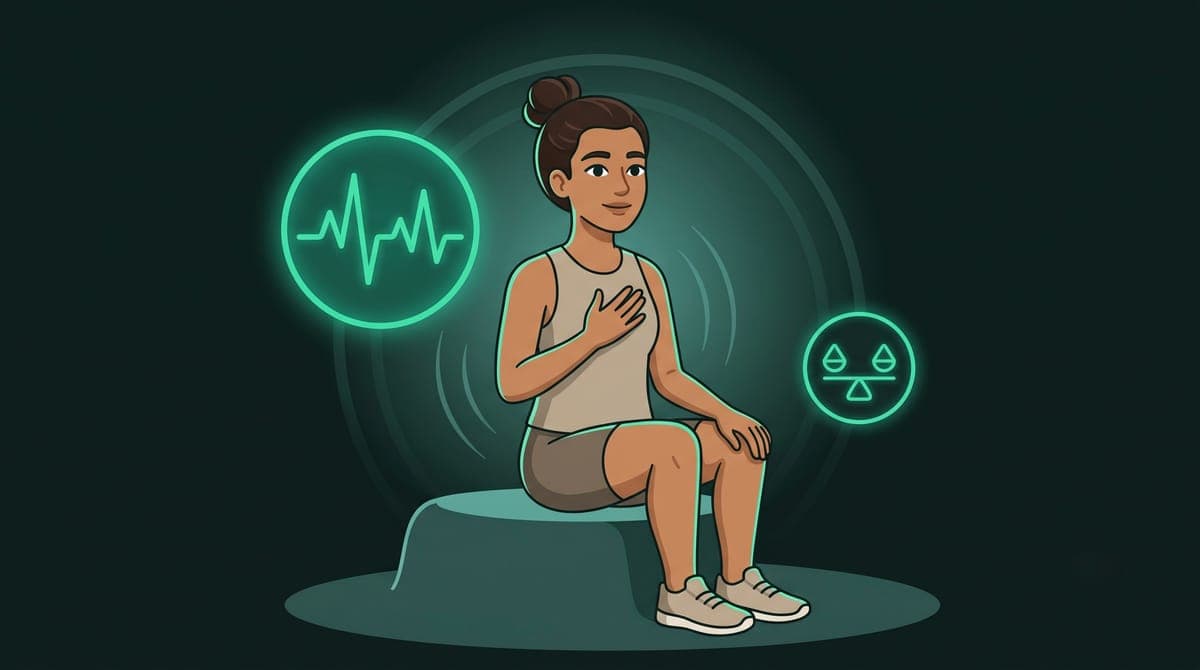
Heart rate variability is one of the more useful objective recovery signals, and it does shift with the cycle. A systematic review and meta-analysis of within-person changes in cardiac vagal activity across the menstrual cycle (Schmalenberger et al., 2019) found that vagally-mediated HRV tends to be higher in the follicular phase and lower in the luteal phase, though the authors noted variability in methods and in the size of the effect across studies.
The practical consequences are less exciting than they sound:
- Compare each day against your own recent average, not against a different phase. A luteal reading that is typical for you is not a red flag.
- Relative change is the signal. A sharp drop below your own recent baseline means more than a generally lower reading that is normal for that part of your cycle.
- Measure consistently, ideally on waking, before caffeine or training, or the noise will swamp anything you are trying to see.
- HRV is one input, not a verdict. Pair it with sleep, pain, and what you actually lifted. The HRV guide covers the mechanics.
Muscle Damage and Soreness
Estrogen has anti-inflammatory properties, and this is often extended into a confident claim that you recover faster in the follicular phase. The evidence is weaker than that.
A systematic review and meta-analysis of exercise-induced muscle damage across the menstrual cycle (Romero-Parra et al., 2021) examined markers such as creatine kinase and measures of soreness and force recovery. The overall picture from this literature is inconsistent: some studies report phase differences, others do not, and the pooled effects are limited by small samples and by how phase was verified in the original studies.
So treat inflammation-based reasoning as background physiology rather than as a scheduling input. If your soreness log shows a repeatable pattern for you, act on your log.
What to Program
Here is the part that matters, and it is short.
Run one consistent, well-structured week. The same volume, intensity, and exercise selection, every week. That week runs the same in your menstrual phase and in your luteal phase.
Monday: upper body strength. Tuesday: lower body strength. Wednesday: rest or a walk. Thursday: upper body. Friday: lower body. Weekend: active recovery or rest.
Adjust individual sessions from logged signals, not from the date. On a day where two or more of your signals are flagging (poor sleep, pain, HRV well below your own baseline, deep soreness, or missed reps in the last session), ease that session: same exercises and loads, roughly a third fewer working sets, one extra rep in reserve. Two rough days back to back is a stronger reason to pull a deload forward than any calendar date.
Deload when accumulated fatigue calls for it. Programmed deloads every few weeks handle accumulated fatigue for everyone. No cycle phase substitutes for one, and no cycle phase requires one.
If a real pattern emerges in your own data, plan around your pattern. If your late-luteal days are consistently rough across several cycles, put your lightest scheduled session there. That is individualisation from evidence you collected, which is a completely different thing from stamping a population template onto your calendar. The symptom tracking guide covers how to gather it.
Recovery Tools, Keyed to How You Feel
None of these are keyed to a calendar date.
- The basics, every day. Protein and carbohydrate after training, consistent sleep, and light movement on rest days.
- When soreness is high. Reduce the load of the next session rather than adding a recovery gadget. Time and sleep do most of the work.
- Cold water immersion, sparingly. It can reduce soreness, but using it after every session may blunt the training adaptation you are chasing. Save it for when you genuinely need to perform again quickly.
- Supplements. We do not publish doses here. If you are considering supplementation for symptoms or recovery, that is a conversation with a clinician or a registered dietitian who can see your full picture.
When Recovery Problems Are Not a Programming Problem
Persistent poor recovery alongside cycle changes deserves attention rather than a smarter deload. If your periods have become irregular or stopped, or you are seeing chronic fatigue, frequent illness, and stalled progress together, low energy availability is a documented possibility in active people and is covered in the IOC consensus statement on Relative Energy Deficiency in Sport (2023). That is a clinician conversation.
Keep Reading
- Symptom tracking: turning daily ratings into add-load, hold, or deload decisions
- Menstrual cycle and training: the full four-phase picture and where the evidence stands
- HRV and recovery and sleep and recovery: the underlying mechanics, independent of the cycle
- Science and evidence: the equations and references behind the numbers we publish
Sources
- Baker FC, Lee KA. Menstrual cycle effects on sleep. Sleep Medicine Clinics, 2018.
- Schmalenberger KM, Eisenlohr-Moul TA, Würth L, et al. A systematic review and meta-analysis of within-person changes in cardiac vagal activity across the menstrual cycle. Journal of Clinical Medicine, 2019.
- Romero-Parra N, Cupeiro R, Alfaro-Magallanes VM, et al. Exercise-induced muscle damage during the menstrual cycle: a systematic review and meta-analysis. Journal of Strength and Conditioning Research, 2021.
- Colenso-Semple LM, D'Souza AC, Elliott-Sale KJ, Phillips SM. Current evidence shows no influence of women's menstrual cycle phase on acute strength performance or adaptations to resistance exercise training. Frontiers in Sports and Active Living, 2023.
- Mountjoy M, Ackerman KE, Bailey DM, et al. 2023 International Olympic Committee's (IOC) consensus statement on Relative Energy Deficiency in Sport (REDs). British Journal of Sports Medicine, 2023.
Frequently asked questions
Why is my HRV low before my period?
Progesterone raises core temperature and sympathetic activity in the luteal phase, and sleep is often more disrupted, both of which lower HRV. A modest luteal dip is normal and expected; compare readings to the same phase in previous cycles rather than to your follicular baseline.
Does the menstrual cycle affect sleep?
Many women sleep worse in the late luteal phase and the first days of menstruation because of higher core temperature, cramps and hormonal shifts. A cooler bedroom, consistent wake time and reduced evening caffeine help most in that window.
Should I deload during my period?
Not automatically. Deload when performance, recovery scores and symptoms say so, which for some women coincides with the late luteal phase or the first days of bleeding, and for others does not. Let three cycles of data decide.
How do I use HRV across my cycle?
Track it daily and compare like with like: this luteal phase against previous luteal phases. A reading lower than your usual for that phase is a real signal; a reading lower than your follicular peak is just the cycle.