Luteal Phase Nutrition: Calories, Cravings, and What Actually Changes
8 min read · April 2025 · by Manikanta Sirumalla
The luteal phase is where most people feel like their nutrition plan falls apart. Hunger gets louder, cravings show up, the scale jumps, and the internet is ready with an explanation: your metabolism has sped up, so eat more.
The measured version is smaller and messier than that. Train and recover, and eat, by the symptoms and performance you actually log, not by assuming a calendar phase guarantees strength, calories, or recovery. There is no automatic calorie surplus to bank here. What there is: a modest and inconsistent change in resting metabolism, real variation in appetite between people and between cycles, and fluid shifts that make the scale unreliable for a few days.
What Progesterone Actually Does
After ovulation, the corpus luteum produces progesterone, which becomes the dominant hormone for the second half of the cycle. Two effects are well established. Progesterone is thermogenic, raising core body temperature by roughly 0.3 to 0.5 degrees Celsius, and it promotes fluid retention. Fuel use shifts modestly toward fat oxidation, with a corresponding small reduction in reliance on carbohydrate at rest.
Everything downstream of that is where the confident numbers start outrunning the data.
The Metabolism Question, With the Actual Numbers
You will see the claim that the luteal phase adds 100 to 300 calories per day to your requirements. The systematic review and meta-analysis on this question (Benton, Hutchins, and Dawes, 2020) pooled the studies measuring resting metabolic rate across the cycle. It found resting metabolism was higher in the luteal phase than the follicular phase, but the difference was modest, and the authors described the underlying studies as heterogeneous, using varied methods and varied phase verification.
Three things follow from that:
- The direction is probably real; the magnitude is uncertain. A modest average increase is not a licence to add a fixed number to your target.
- The between-person spread is wide. Studies report anything from no difference to a noticeable one, so the group average is a poor prediction of your own requirement.
- A calendar-scheduled surplus is the wrong tool even if the effect were larger, because you cannot know whether it applies to you without looking at your own intake, weight trend, and hunger.
The practical instruction: do not add calories by the calendar. Eat to your computed targets, honour genuine hunger when it shows up, and let your two-week weight trend tell you whether your targets need adjusting. If you want to know how those targets are built in the first place, the TDEE guide and the macro calculation guide cover the arithmetic.
Hunger and Intake Vary, and That Is Normal
Appetite genuinely does change for many people across the cycle. Research measuring dietary intake across cycle phases in healthy premenopausal women has reported higher energy intake in the luteal phase (Gorczyca et al., 2016), which lines up with what most people notice. Just as importantly, it does not happen to everyone, and it does not happen to the same degree every cycle.
That combination, real but variable, is exactly the case for logging rather than prescribing. If your own log shows appetite reliably rising for a few days, eat a bit more on those days and accept the small variance in your weekly average. That is different from writing a surplus into your plan every month regardless of what you feel.
Handling Cravings Without a Rule Book
A strong desire for carbohydrate or sweet food in the second half of the cycle is common. Whatever the mechanism, the practical question is what to do about it, and the useful answers are mundane:
- Eat enough protein and fibre across the day. Both help with fullness, and both are usually the first casualties of a chaotic day.
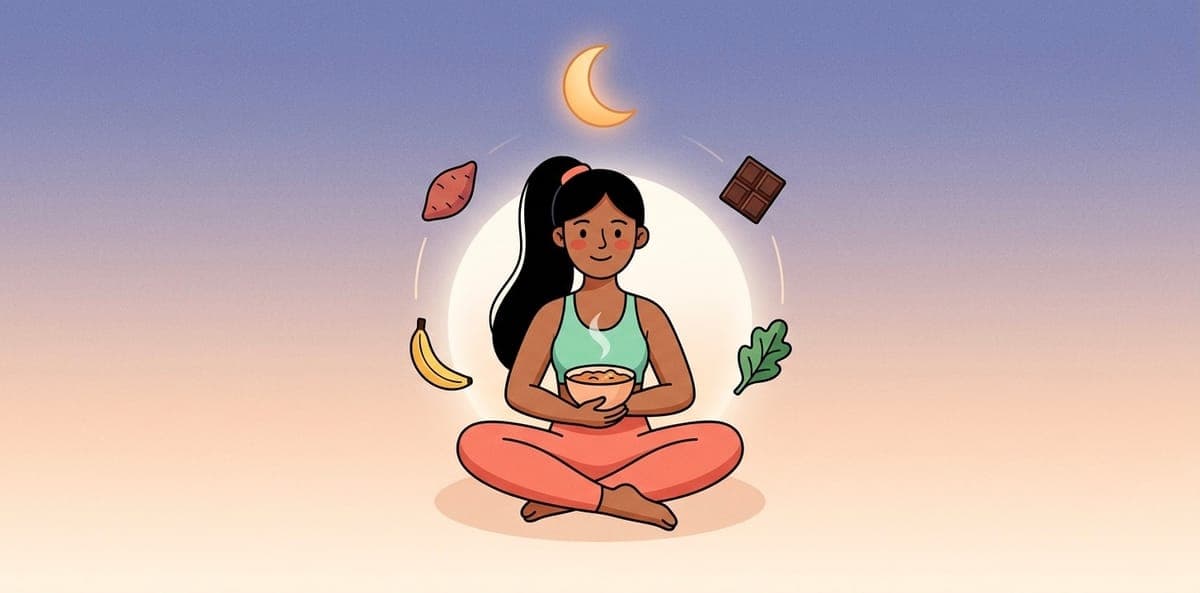
- Answer the craving with food that also feeds you. Oats with fruit and dark chocolate will do more for the next three hours than the same calories from a snack that leaves you hungry again.
- Do not white-knuckle a fat-loss phase through a bad week. If hunger and symptoms are genuinely disruptive, easing closer to maintenance for a few days is reasonable. Drive that off what you log, not off the date.
- Do not treat a craving as a mandate to overeat, and do not treat it as a failure of discipline either. It is information.
The Scale Is Unreliable Here, and That Is Fine
Progesterone-driven fluid retention can add a couple of pounds during the second half of the cycle. That is water. Nothing about it requires a dietary response.
Two habits make this manageable. Use the same window each cycle as your comparison point, ideally the early-to-mid follicular phase, so that you are comparing like with like. And if you know fluid retention peaks for you in the days before your period, either skip those weigh-ins or mark them as noise rather than letting them steer a decision.
Micronutrients, Honestly
You will find confident recommendations that specific supplements at specific doses fix premenstrual symptoms. Some of these have been studied, and the trials are generally small, heterogeneous, and inconsistent, which is why guideline bodies do not make strong recommendations from them.
Our position: food first, and no doses here. Eating a varied diet that covers the basics is a reasonable goal regardless of the cycle. If your symptoms are severe enough that you are considering supplementation as treatment, that is a conversation for a clinician or a registered dietitian who can look at your history, your medication, and your actual intake. This article will not hand you a dose, because a dose is a clinical decision.
What Does Not Change
- Protein. Your target is set by body weight, training, and goal, not by the calendar. Keep it steady.
- Your program. Volume, intensity, and exercise selection stay the same. Ease individual sessions when your log says to, as covered in the symptom tracking guide.
- The fundamentals. Sleep, total intake, and consistency dominate any phase effect that exists.
Keep Reading
- Symptom tracking: how to tell a real appetite pattern from a bad week
- Menstrual cycle and training: why the same logic applies to training volume
- How to calculate your TDEE and how to calculate macros: the targets you should be eating to all month
- Science and evidence: the equations and references behind the numbers we publish
Sources
- Benton MJ, Hutchins AM, Dawes JJ. Effect of menstrual cycle on resting metabolism: a systematic review and meta-analysis. PLOS ONE, 2020.
- Gorczyca AM, Sjaarda LA, Mitchell EM, et al. Changes in macronutrient, micronutrient, and food group intakes throughout the menstrual cycle in healthy, premenopausal women. European Journal of Nutrition, 2016.
- Colenso-Semple LM, D'Souza AC, Elliott-Sale KJ, Phillips SM. Current evidence shows no influence of women's menstrual cycle phase on acute strength performance or adaptations to resistance exercise training. Frontiers in Sports and Active Living, 2023.
- McNulty KL, Elliott-Sale KJ, Dolan E, et al. The effects of menstrual cycle phase on exercise performance in eumenorrheic women: a systematic review and meta-analysis. Sports Medicine, 2020.
Frequently asked questions
Why am I so hungry before my period?
Progesterone increases appetite and slightly raises energy expenditure, serotonin dips can drive carbohydrate cravings, and poorer sleep in the late luteal phase raises hunger hormones. The hunger is real; the extra energy need is small.
Should I eat more calories in the luteal phase?
Not as a rule. Resting expenditure rises by a modest amount for some women and not others, and the data is too weak to set a phase-specific target. Keep your targets steady and, if hunger is consistently higher, spend the difference on protein and fibre rather than raising the target every cycle.
Why do I gain weight in the luteal phase?
Water retention from progesterone and higher sodium sensitivity, plus slower digestion, can add 1 to 2 kg that disappears within days of the period starting. It is not fat. Judge fat loss by comparing the same phase across cycles.
What should I eat in the luteal phase?
Complex carbohydrates (oats, potatoes, whole grains) to steady blood sugar and cravings, protein at every meal, magnesium- and calcium-rich foods (leafy greens, dairy, nuts) that have some evidence for easing PMS symptoms, and moderate sodium to limit bloating.
Does metabolism increase in the luteal phase?
Slightly, by roughly 2 to 10 percent in some studies, mostly through the higher core temperature. The effect is smaller than daily variation in activity and does not warrant a change in intake.