Overtraining vs. Overreaching: Signs, Symptoms, and Fixes
9 min read · September 2026 · by Manikanta Sirumalla
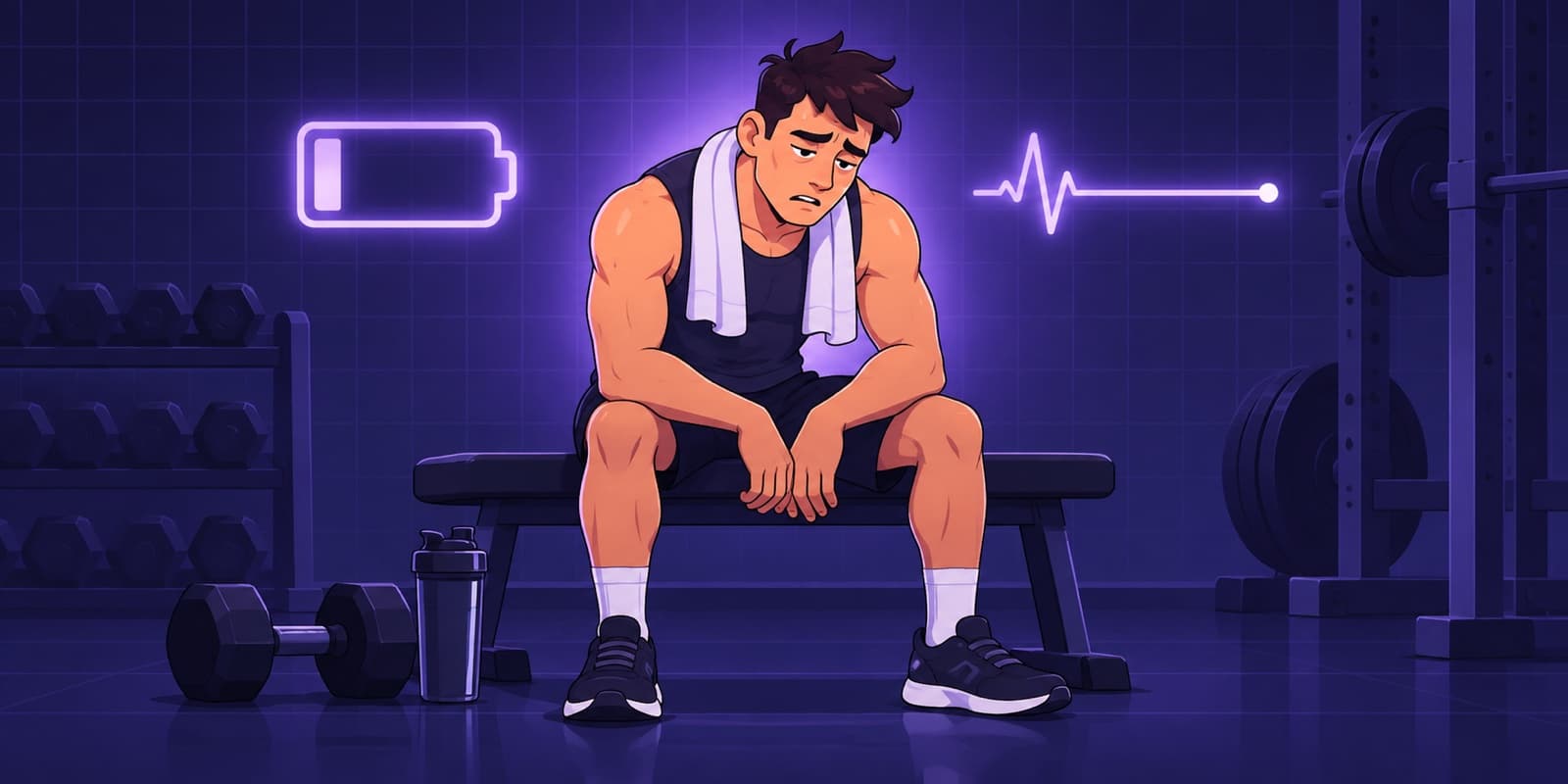
"Overtrained" is one of the most overused words in fitness, and one of the most misdiagnosed. The genuine condition, overtraining syndrome, is rare, serious, and mostly confined to elite endurance athletes. What most hard-training people experience is something else: overreaching, or plain under-recovery, and those have different timelines and different fixes. Getting the label right is the first step to getting better.
The three states
The consensus statement from the European College of Sport Science and the American College of Sports Medicine defines a continuum (Meeusen et al. 2013):
Functional overreaching. A short-term drop in performance after a period of intense training, which recovers within days to about two weeks of reduced load and is followed by a rebound above the previous level. This is normal, often deliberate, and is what a hard training block followed by a deload is designed to produce. See The Deload Week.
Non-functional overreaching. A longer performance decline, lasting weeks to a couple of months, with no rebound. Accompanied by psychological symptoms: low mood, irritability, disturbed sleep, loss of motivation. Recoverable, but the training that caused it was wasted rather than productive.
Overtraining syndrome. A prolonged performance decline of months or longer, with multi-system symptoms including hormonal disturbance, immune suppression, sleep disruption and mood changes, that does not resolve with a couple of weeks of rest. It is a diagnosis of exclusion; illness, under-eating and other medical causes must be ruled out first. It is uncommon, and most of the literature comes from endurance and team sports rather than lifting.
The distinguishing feature is how long recovery takes once you reduce load. Days: functional. Weeks: non-functional. Months: overtraining syndrome.
Why it is usually not just training
The consensus is explicit that overtraining syndrome is rarely caused by training load alone. The state arises when total stress exceeds recovery capacity, and total stress includes:
- Energy availability. Training hard while under-eating produces relative energy deficiency in sport (RED-S), a condition with hormonal suppression, bone loss, poor recovery, frequent illness and low mood (Mountjoy et al. 2018). Its symptoms overlap almost completely with overtraining, and it is far more common. Any "overtrained" person who is also dieting should look here first.
- Sleep. Chronic short sleep reduces recovery capacity, hormonal function and immunity. Many overreaching cases are sleep cases.
- Life stress. Work, relationships and financial stress consume the same recovery resources as training. Studies find life stress predicts injury and slows strength gains independently of training load (Stults-Kolehmainen and Sinha 2014).
- Illness and travel. A cold, jet lag or a run of poor sleep can tip a manageable load into overreaching.
- Monotony. The same high load, day after day, without variation or easy days, is more likely to cause problems than the same weekly total with hard and easy days mixed.
The warning signs
No single marker diagnoses overreaching or overtraining. The pattern across several, over two weeks or more, is what matters (Kreher and Schwartz 2012).
Performance. The primary sign. Lifts stall or fall for two or more weeks despite normal effort. Familiar weights feel heavy. RPE for a given load rises. In cardio, pace at a given heart rate falls. See Signal vs Noise: Real Strength Progress for distinguishing a bad week from a trend.
Resting heart rate. Elevated by several beats above your baseline for several consecutive mornings. See Resting Heart Rate.
HRV. A sustained downward trend against your own baseline, not a single low reading. In advanced overtraining, HRV can paradoxically rise as the parasympathetic system dominates, which is why trend plus context beats any single number. See HRV and Recovery.
Sleep. Trouble falling or staying asleep despite exhaustion, or waking unrefreshed. See Sleep and Recovery.
Mood and motivation. Irritability, low mood, anxiety, dreading sessions you used to look forward to. Subjective wellbeing questionnaires actually outperform physiological markers for detecting overreaching in the research (Saw et al. 2016).
Illness. More frequent colds and slow healing of minor injuries.
Appetite and weight. Loss of appetite, or unexplained weight loss.
Aches. Persistent joint and tendon soreness beyond normal DOMS; a sense of being generally beaten up.
Hormonal and menstrual. Missed or irregular periods in women, reduced libido in everyone. These point strongly toward low energy availability.
A practical threshold: if three or more of these have been present for two weeks and performance is down, act.
Overreaching in lifters specifically
True overtraining syndrome is rare in resistance training, because sessions are short and fatigue is mostly local to the muscles worked. What lifters get is non-functional overreaching, and it has a recognisable shape (Bell et al. 2020):
- Several weeks of high volume, high intensity, or both, without a deload.
- Training to failure frequently.
- Lifts that stopped progressing and then started going backwards.
- Nagging joint and tendon pain, especially elbows, shoulders and knees.
- Poor sleep, low drive, and the feeling that warm-up weights are heavy.
It is almost always fixed by a deload week and a look at total volume, frequency of failure, sleep and food. Structural prevention is a deload every four to eight weeks, most sets stopped one to three reps short of failure, and volume that matches recovery capacity. See Training Volume and RIR: Reps in Reserve.
How to recover
Functional overreaching. Nothing to fix. Take the planned deload or a few easy days, eat well, sleep, and expect a rebound.
Non-functional overreaching. Reduce training volume by 40 to 60 percent for one to two weeks while keeping some intensity and movement, then rebuild gradually over two to four weeks. Eat at maintenance or slightly above, with adequate carbohydrate; this is not the time for a deficit. Prioritise sleep above everything. Address the life stress if you can. Reintroduce hard training only when performance and mood have returned to baseline, and build in regular deloads afterward.
Suspected overtraining syndrome. Substantially reduce training for weeks; some athletes need months. See a doctor to rule out illness, anaemia, thyroid problems, and to assess for RED-S. Correct energy intake, sleep and stress. Return to training very gradually, guided by mood and performance rather than a calendar. Prevention is far easier than cure.
In all cases, check food first. If you have been in a deficit while training hard, the deficit is probably the primary problem. Raising intake to maintenance for two to four weeks often resolves symptoms that looked like overtraining. See Maintenance Calories and Reverse Dieting.
Prevention
- Periodise. Hard blocks of three to six weeks followed by a deload. See Periodization.
- Do not train to failure on everything. Reserve it for the last set of isolation work.
- Eat enough, especially carbohydrate around hard training, and never combine a large deficit with a high-volume block.
- Sleep seven to nine hours and protect it.
- Track more than the weights. A simple daily wellbeing score (sleep, mood, energy, soreness, each out of five) predicts problems better than any device.
- Use your wearable as context, not as a verdict. A falling HRV trend and rising resting heart rate alongside a stalled log is a signal to back off; a single bad reading is not.
- Match load to life. During high-stress weeks at work, train, but train at maintenance.
The bottom line
Most "overtraining" is overreaching or under-recovery, and it resolves in days to weeks with a deload, more food and more sleep. True overtraining syndrome is rare, takes months, and is almost always training load compounded by under-eating, poor sleep and life stress. Watch for performance falling for two weeks or more alongside rising resting heart rate, falling HRV, poor sleep and low mood, and when you see that pattern, reduce load and check your food before anything else. Plan deloads so you rarely have to.
Sources
- Meeusen R, Duclos M, Foster C, et al. "Prevention, diagnosis, and treatment of the overtraining syndrome: joint consensus statement of the European College of Sport Science and the American College of Sports Medicine." Medicine and Science in Sports and Exercise, 2013.
- Kreher JB, Schwartz JB. "Overtraining syndrome: a practical guide." Sports Health, 2012.
- Mountjoy M, Sundgot-Borgen JK, Burke LM, et al. "IOC consensus statement on relative energy deficiency in sport (RED-S): 2018 update." British Journal of Sports Medicine, 2018.
- Stults-Kolehmainen MA, Sinha R. "The effects of stress on physical activity and exercise." Sports Medicine, 2014.
- Saw AE, Main LC, Gastin PB. "Monitoring the athlete training response: subjective self-reported measures trump commonly used objective measures: a systematic review." British Journal of Sports Medicine, 2016.
- Bell L, Ruddock A, Maden-Wilkinson T, Rogerson D. "Overreaching and overtraining in strength sports and resistance training: A scoping review." Journal of Sports Sciences, 2020.
Frequently asked questions
What are the first signs of overtraining?
Performance that stalls or falls for two or more weeks despite normal effort, unusually high perceived effort for familiar weights, resting heart rate a few beats above your baseline for several days, HRV trending down, poor sleep despite fatigue, irritability or low motivation, and more frequent colds. Any one is noise; several together over two weeks is a signal.
What is the difference between overreaching and overtraining?
Duration and severity. Functional overreaching is a planned, short performance dip that produces a rebound after a few days of rest. Non-functional overreaching is a longer dip of weeks with no rebound. Overtraining syndrome is a prolonged decline of months with mood, sleep, hormonal and immune disturbances. Most lifters who feel overtrained are in the first or second category.
How long does it take to recover from overtraining?
Functional overreaching: days to a week. Non-functional overreaching: two to six weeks of reduced load. True overtraining syndrome: often months, sometimes more, with substantially reduced training, medical review and correction of any under-eating, sleep or stress problems.
Can you overtrain with weights?
True overtraining syndrome is uncommon in resistance training because sessions are short and fatigue is mostly local. What lifters commonly experience is non-functional overreaching: joint aches, stalled lifts, poor sleep and low drive after weeks of high volume without deloads. A deload week usually resolves it.
Does a low HRV mean I am overtrained?
A single low reading means nothing. A sustained downward trend against your own 30-day baseline, combined with a rising resting heart rate and a performance decline, is a meaningful signal of under-recovery. Wearable metrics are context for the training log, not a diagnosis on their own.
Is overtraining really just under-eating?
Often a large part of it. Low energy availability (RED-S) produces many of the same symptoms, including hormonal suppression, poor recovery and frequent illness, and is common in people who train hard while dieting. Checking that you are eating enough is the first step in any recovery plan.