Metabolic Metrics Explained: BMR, RMR, TDEE, and Body Composition
7 min read · April 2025 · by Manikanta Sirumalla

A screen full of metabolic numbers is only useful if you know what each one is, how it was produced, and how much to trust it. This page explains the metrics themselves, which is knowledge that outlives any particular app screen.
This page is held out of search while the in-app metabolic surface is being reconciled against the shipping build. The explanations below are about the metrics, not a claim about which screens exist in your version. Where a number appears in the app, it is calculated from the profile data you entered, so it changes when your inputs change and it is only ever as good as those inputs.
Body Composition Metrics
BMI
Your weight-to-height ratio. BMI is a population screening tool and a blunt one for individuals: it cannot distinguish muscle from fat, so a heavily muscled person and a sedentary person of the same height and weight get the same value. Treat it as context, never as a target.
Body Fat Percentage
The estimated proportion of your mass that is fat. This is the more informative composition metric, and the word to hold onto is estimated. Field methods, including circumference-based estimates and consumer scales, carry meaningful error. The trend over weeks is far more useful than any single reading. The body fat percentage guide covers the measurement methods and their error ranges.
Fat-Free Mass
Everything that is not fat: muscle, bone, organs, water, connective tissue. Fat-free mass holding or rising while fat mass falls is the outcome most people are actually after. A rapid drop in fat-free mass during a diet usually means the deficit is too aggressive, protein is too low, or resistance training has dropped off.
The Lean-to-Fat Picture
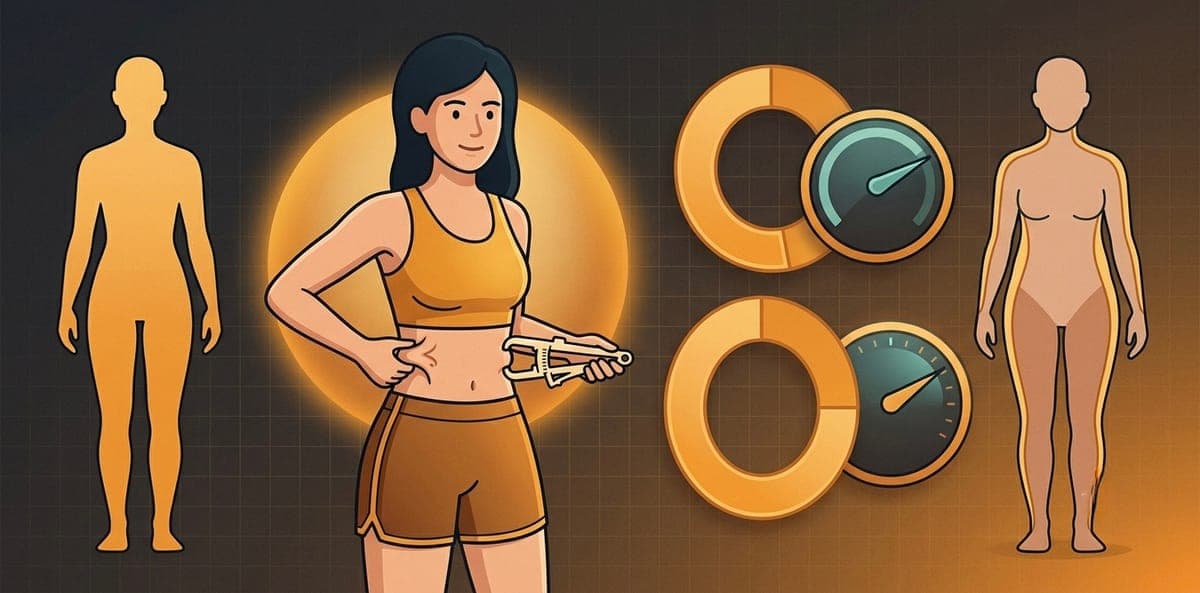
Seeing fat-free mass, fat mass, and body fat percentage together is the point. Any one of them in isolation invites the wrong conclusion, most often from BMI alone.
The Calorie Pipeline
Four numbers build on each other, and knowing which is measured and which is estimated keeps you honest about all of them.
BMR
Basal metabolic rate: the energy cost of keeping you alive at complete rest. It is estimated with a predictive equation rather than measured. The Mifflin-St Jeor equation is the standard reference for this, and where fat-free mass is known, equations that use it can be more accurate for people whose body composition is far from average. Predictive equations carry error for any individual, which is the single most important caveat on this whole page. The BMR versus RMR guide compares the equations.
RMR
Resting metabolic rate: energy expenditure under real-world resting conditions, typically slightly higher than BMR. Think of BMR as the theoretical floor and RMR as the practical one.
TDEE
Total daily energy expenditure: everything, including movement and training. It is produced by applying an activity multiplier to your resting estimate, and the multiplier is the largest source of error in the whole chain. The gap between two adjacent activity levels is often a few hundred calories, so an honest self-assessment matters more than any refinement further up the pipeline. The TDEE guide covers this properly.
Target Calories
Your TDEE with a goal-based offset applied: below for fat loss, above for gain, equal for maintenance. This is the number you actually eat to, and it is an estimate built on two prior estimates.
Macro Targets
Calories split into protein, carbohydrate, and fat. A sensible approach sets protein relative to body weight and goal, sets fat to a floor that supports general health, and assigns the remainder to carbohydrate. The resulting percentages are an output of that process, not an input, which is why chasing a particular macro ratio is usually the wrong place to spend attention. The macro calculation guide covers the arithmetic.
Hydration Targets
Body size and activity drive a rough daily fluid target. Treat it as a starting point rather than a prescription: heat, humidity, training intensity, and caffeine all move real requirements, and thirst plus urine colour will tell you more than a fixed number.
Using Estimates Without Over-Trusting Them
Every number above is a model output. Use them the way you would use any estimate.
Keep the inputs current. Weight changes shift everything downstream. Weigh under consistent conditions and update every week or two.
Reassess activity level honestly. It is the largest error source in the TDEE estimate.
Verify against reality. Give a calorie target two weeks, track your average weight trend rather than individual readings, and adjust based on what actually happened. If the maths says one thing and your trend says another, your trend is right and the estimate was wrong.
Do not chase precision the model cannot deliver. Recalculating your BMR to the calorie while ignoring a two-hundred-calorie error in your activity multiplier is effort spent in the wrong place.
Keep Reading
- How to calculate your TDEE
- BMR versus RMR explained
- Body fat percentage: methods and error
- Science and evidence: the equations and references behind the numbers we publish