Intermittent Fasting and Training: What the Evidence Says
9 min read · September 2026 · by Manikanta Sirumalla

Intermittent fasting has moved from fringe to mainstream in a decade. A 16-hour fast and an 8-hour eating window, a 5:2 pattern, alternate-day fasting, a single meal a day: all have advocates, and the claims attached to them run from "burns fat faster" to "preserves muscle" to "extends life." For people who train, the useful question is narrower: does fasting change what happens to fat and muscle, and how should training fit around it? The controlled trials give a clear answer.
What fasting is, and what it is not
Every form of intermittent fasting restricts when you eat. Whether it restricts how much is up to you. Time-restricted eating (16/8 and its variants) shortens the daily window; 5:2 and alternate-day fasting cut calories hard on some days and not others.
The effects that appear in trials come almost entirely from the calorie reduction that fasting usually produces, not from the fasting itself. That is the central finding, and everything else follows from it.
Fat loss: the same as any other deficit
Trials that compare intermittent fasting with ordinary continuous calorie restriction, at matched calories, find equivalent fat loss.
A year-long trial of alternate-day fasting versus daily restriction in obese adults found no difference in weight or fat loss, and a higher dropout rate in the fasting group (Trepanowski et al. 2017). The largest trial of time-restricted eating, in which 139 obese adults ate within an 8-hour window or without time limits for 12 months, both on the same calorie restriction, found no difference in weight, fat, or metabolic markers between the groups (Liu et al. 2022). A trial of 16/8 without any calorie prescription found the fasting group lost slightly more weight than controls, but part of that was lean mass, and the weight loss was modest (Lowe et al. 2020).
Reviews pooling these and other studies conclude the same thing: intermittent fasting works as well as continuous restriction when calories are matched, no better (Cioffi et al. 2018). Its real advantage is behavioural. Some people find it far easier to skip breakfast and eat freely in the evening than to eat small portions all day. If that is you, fasting is a useful tool. If it makes you ravenous and overeat in the window, it is not.
See Calorie Deficit vs. Surplus and Meal Timing.
Muscle: protein and training decide
The fear with fasting is that long gaps without protein cost muscle. The evidence is more nuanced.
In the best-known lifting study, trained men followed a 16/8 window or a normal eating pattern for eight weeks, both with the same calories and protein and the same training. The fasting group lost fat while keeping muscle mass and strength; the normal group kept both without losing fat (Moro et al. 2016). Similar results appeared in women in a subsequent study (Tinsley et al. 2019), and a trial that combined fasting with a calorie deficit and resistance training found muscle was maintained when protein was adequate (Stratton et al. 2020).
But the study without a protein prescription told a different story: 16/8 alone, in people who were not training and not tracking protein, produced a disproportionate loss of lean mass (Lowe et al. 2020). And the Moro study found testosterone and IGF-1 slightly lower in the fasting group, a small hormonal cost that did not translate into muscle loss over eight weeks but is worth knowing.
The pattern is consistent with everything else we know about muscle:
- Total daily protein of 1.6 to 2.2 g/kg is what preserves muscle. See How Much Protein.
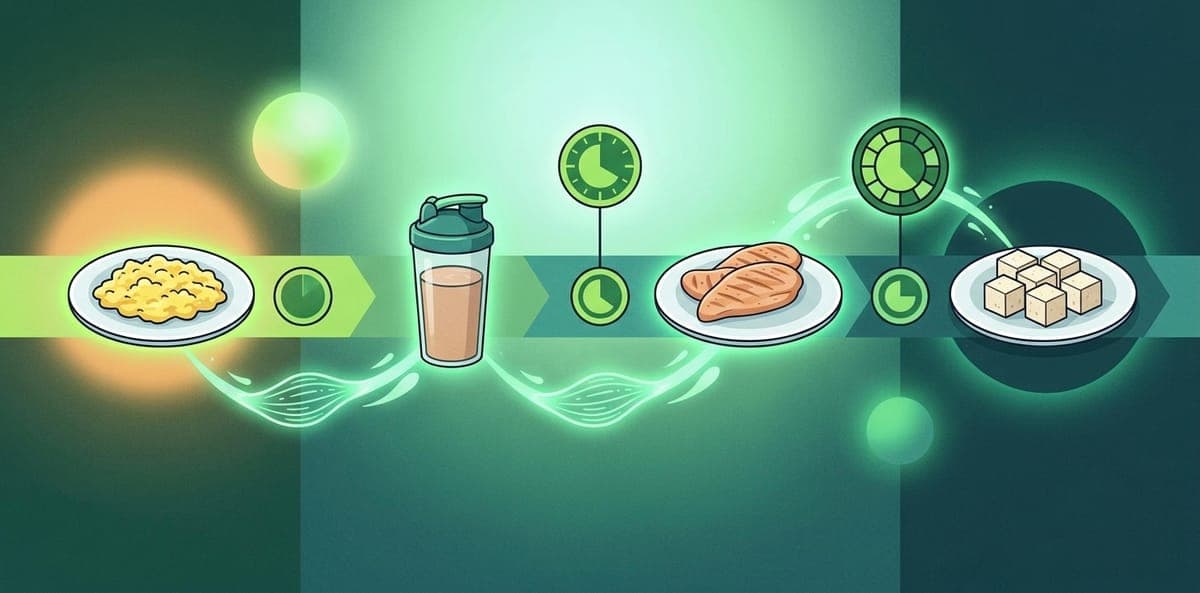
- Spreading it over three to five feedings of 30 to 40 g is better than two large meals, because the muscle-building response per meal plateaus (Schoenfeld and Aragon 2018). See Protein Timing.
- Resistance training is the signal that tells the body to keep muscle in a deficit.
A 16/8 window can hold three protein feedings if they are planned. A 4-hour window or a single meal a day cannot, and the muscle cost of those approaches is real for people who train.
Training fasted
Strength. Short, moderate sessions are usually fine fasted; muscle glycogen is not depleted by a 16-hour fast. Longer or higher-volume sessions, especially with many sets in the 8 to 15 rep range, tend to suffer, and perceived effort rises. A meta-analysis of fasted versus fed exercise found that pre-exercise feeding improved performance in longer sessions and made no consistent difference in short ones (Aird et al. 2018).
Cardio. Fasted cardio burns a higher proportion of fat during the session and a lower proportion afterward, and fat loss over weeks is the same as fed cardio at matched calories (Schoenfeld et al. 2014). See Walking for Fat Loss for why session-level fat burning does not matter.
Recovery. Training fasted and then waiting several hours to eat delays muscle protein synthesis and glycogen replenishment. The "anabolic window" is wide, but not infinitely so; the practical rule is protein within a couple of hours of training, sooner if the previous meal was long ago. See Post-Workout Nutrition.
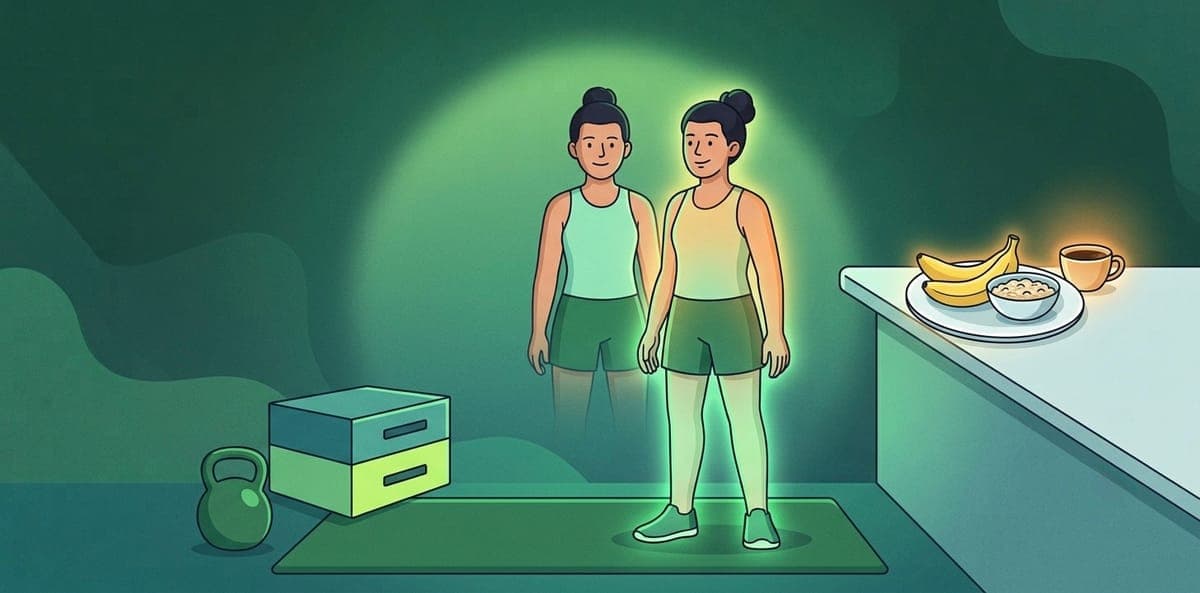
The best arrangement, if you fast, is to train inside the eating window or immediately before its first meal, so training is either fed or followed quickly by food. Training in the middle of a 16-hour fast, with food hours away on either side, is the worst arrangement for muscle. See Pre-Workout Nutrition.
Women and fasting
Most fasting trials were done in men or in mixed groups where sex differences were not analysed. The data specifically in women is thinner and includes some warning signs.
An early trial of alternate-day fasting found that women's glucose tolerance worsened while men's improved (Heilbronn et al. 2005). Reproductive hormones are sensitive to energy availability, and women's bodies respond to signals of scarcity by down-regulating the cycle; this is the mechanism behind exercise-related amenorrhoea and relative energy deficiency in sport. A long daily fast combined with hard training and a calorie deficit can push some women into that territory, with irregular periods, poor sleep, and mood changes. The evidence that fasting is uniquely harmful for women beyond that mechanism is weak, and many women use moderate fasting without problems.
Practical guidance:
- Moderate windows (12 to 14 hours of fasting) carry little risk for most healthy women.
- Longer fasts, combined with hard training and a deficit, deserve caution and cycle tracking. Missed or irregular periods are a signal to stop.
- Anyone with irregular cycles, PCOS, a history of disordered eating, or who is pregnant, breastfeeding or trying to conceive should avoid extended fasting.
- Perimenopausal women, whose sleep and stress systems are already under load, often do worse on long fasts.
See Menstrual Cycle and Training, Iron Deficiency in Active Women, and Overtraining vs. Overreaching for the energy-availability picture.
Longevity and metabolic health
Animal studies of fasting and lifespan are striking; human data is early. In humans, the metabolic improvements seen with time-restricted eating in trials are largely those of weight loss, and disappear when compared with weight-matched controls (Liu et al. 2022). There is some evidence that eating earlier in the day (an early window) improves glucose control slightly compared with a late window, which argues for a morning-to-early-evening pattern if you fast. Claims about autophagy and cellular repair are mechanistic extrapolations from animal work, not demonstrated human outcomes.
How to make it work if you like it
- Choose a moderate window. 10 to 12 hours of eating (for example 8 am to 7 pm) captures most of the adherence benefit and none of the muscle cost. 16/8 works with planning; shorter windows do not, for lifters.
- Put training in the window. Train fed, or immediately before the first meal.
- Hit protein in three or four feedings. 30 to 40 g each, with the first soon after the fast ends and the last near the end of the window. Casein or Greek yoghurt as the last feeding covers the overnight fast.
- Do not let fasting become an excuse to skip the calorie maths. Track intake for a couple of weeks; the window does not guarantee a deficit.
- Keep coffee, water and electrolytes in the fasting hours.
- Watch the signals. Falling performance, poor sleep, irritability, missed periods, or binge-eating in the window all mean the pattern is not working for you. Fasting is a tool, not an identity.
The bottom line
Intermittent fasting is a way to eat fewer calories, and it produces the same fat loss as any other way of eating fewer calories. It preserves muscle when protein is high, spread over three or more feedings, and training continues; it costs muscle when the window is too short to manage that. Fasted training burns no extra fat and hurts longer sessions. Women with hard training loads or irregular cycles should keep fasts moderate. If you enjoy it, use a 10 to 12 hour window with training inside it and protein at every meal, and judge it by your log, not by the clock.
Sources
- Trepanowski JF, Kroeger CM, Barnosky A, et al. "Effect of Alternate-Day Fasting on Weight Loss, Weight Maintenance, and Cardioprotection Among Metabolically Healthy Obese Adults: A Randomized Clinical Trial." JAMA Internal Medicine, 2017.
- Liu D, Huang Y, Huang C, et al. "Calorie Restriction with or without Time-Restricted Eating in Weight Loss." New England Journal of Medicine, 2022.
- Lowe DA, Wu N, Rohdin-Bibby L, et al. "Effects of Time-Restricted Eating on Weight Loss and Other Metabolic Parameters in Women and Men With Overweight and Obesity: The TREAT Randomized Clinical Trial." JAMA Internal Medicine, 2020.
- Cioffi I, Evangelista A, Ponzo V, et al. "Intermittent versus continuous energy restriction on weight loss and cardiometabolic outcomes: a systematic review and meta-analysis of randomized controlled trials." Journal of Translational Medicine, 2018.
- Moro T, Tinsley G, Bianco A, et al. "Effects of eight weeks of time-restricted feeding (16/8) on basal metabolism, maximal strength, body composition, inflammation, and cardiovascular risk factors in resistance-trained males." Journal of Translational Medicine, 2016.
- Tinsley GM, Moore ML, Graybeal AJ, et al. "Time-restricted feeding plus resistance training in active females: a randomized trial." American Journal of Clinical Nutrition, 2019.
- Stratton MT, Tinsley GM, Alesi MG, et al. "Four Weeks of Time-Restricted Feeding Combined with Resistance Training Does Not Differentially Influence Measures of Body Composition, Muscle Performance, Resting Energy Expenditure, and Blood Biomarkers." Nutrients, 2020.
- Aird TP, Davies RW, Carson BP. "Effects of fasted vs fed-state exercise on performance and post-exercise metabolism: A systematic review and meta-analysis." Scandinavian Journal of Medicine and Science in Sports, 2018.
- Schoenfeld BJ, Aragon AA, Wilborn CD, Krieger JW, Sonmez GT. "Body composition changes associated with fasted versus non-fasted aerobic exercise." Journal of the International Society of Sports Nutrition, 2014.
- Schoenfeld BJ, Aragon AA. "How much protein can the body use in a single meal for muscle-building? Implications for daily protein distribution." Journal of the International Society of Sports Nutrition, 2018.
- Heilbronn LK, Civitarese AE, Bogacka I, et al. "Glucose tolerance and skeletal muscle gene expression in response to alternate day fasting." Obesity Research, 2005.
Frequently asked questions
Does intermittent fasting burn more fat than a normal diet?
No. Trials comparing intermittent fasting with continuous calorie restriction at matched calories find equivalent fat loss. The largest one-year trial of time-restricted eating found no advantage over ordinary calorie restriction. Fasting works when it helps you eat less, and not otherwise.
Will intermittent fasting make me lose muscle?
Not necessarily. An 8-week trial in trained men using a 16/8 window with maintained protein and training lost fat and kept muscle. The risk rises when the window is short enough to compress protein below 1.6 g/kg or below three meals, and when training is done far from any protein intake. Protein and training, not the clock, decide.
Should I lift weights fasted?
Only if it fits your schedule and your sessions are short. Fasted lifting does not burn more fat over time, and strength performance is usually fine for brief sessions but declines in longer or higher-volume ones. Eating protein and some carbohydrate 1 to 3 hours before is the better default; if you must train fasted, eat a protein-rich meal soon after.
Is fasted cardio better for fat loss?
No. You burn more fat during the session and less afterward, and total fat loss over weeks is identical to fed cardio at matched calories. Do cardio whenever you will actually do it.
Is intermittent fasting safe for women?
For most healthy women with moderate fasts (12 to 14 hours), yes. Long daily fasts (16 hours or more) combined with hard training and low calories can suppress reproductive hormones, disrupt cycles and affect sleep and mood in some women. Anyone with irregular periods, a history of disordered eating, or who is pregnant or breastfeeding should avoid extended fasting.
What is the best fasting window for people who train?
A 10 to 12 hour eating window (for example 9 am to 8 pm) that contains your training and three or four protein-rich meals gives most of the adherence benefit with none of the muscle trade-offs. If you use 16/8, place training in the window or just before its first meal.