Walking for Fat Loss: Why It Beats HIIT for Most People
8 min read · September 2026 · by Manikanta Sirumalla
If exercise were rated by how impressive it looks, walking would come last. Rated by how much fat people actually lose while keeping their muscle and their sanity, it is close to the top. This article makes the case with numbers, explains where HIIT genuinely wins, and shows how to make walking work harder when you want it to.
The problem with high-intensity cardio for fat loss
HIIT burns a lot of calories per minute and improves VO2 max efficiently. Both are true. Neither makes it the best fat-loss tool, for three reasons that show up in the research and in every coach's experience.
Recovery cost. A hard interval session generates fatigue and muscle damage that compete with lifting for recovery. In a calorie deficit, when recovery is already compromised, that competition is expensive. The interference research is clear that high-intensity cardio is where strength and power losses show up (Wilson et al. 2012).
Compensation. Hard exercise increases appetite and reduces spontaneous movement for the rest of the day in many people, an effect measured in studies of energy expenditure (Pontzer et al. 2016). A 400-calorie HIIT session that leads to 300 extra calories eaten and 150 fewer burned in the afternoon nets very little.
Adherence. People do not do HIIT four times a week for months. Trials comparing interval training with moderate continuous exercise for fat loss find similar results when the work is matched, and note that the "time efficiency" of HIIT is offset by lower enjoyment and adherence for many participants (Keating et al. 2017).
Walking has none of these problems. It produces negligible fatigue and no meaningful muscle damage, so it can be done every day and does not interfere with lifting at all. It does not spike appetite. And people keep doing it, because it is pleasant and fits into life.
What walking actually burns
The energy cost of walking is well characterised. On level ground at a normal brisk pace, it is roughly 0.7 to 1.0 calories per kilogram of body weight per kilometre, which means:
| Body weight | Per km | 10,000 steps (about 7.5 km) |
|---|---|---|
| 60 kg | 45 to 60 kcal | 340 to 450 kcal |
| 75 kg | 55 to 75 kcal | 420 to 560 kcal |
| 90 kg | 65 to 90 kcal | 500 to 680 kcal |
Those are gross figures; the net addition over sitting is about 15 to 20 percent lower. Still, going from a sedentary 4,000 steps a day to 10,000 adds roughly 300 to 450 calories of daily expenditure for most adults. Over a week that is 2,000 to 3,000 calories, comparable to five HIIT sessions, at zero recovery cost.
This is the essence of NEAT, non-exercise activity thermogenesis, which varies by up to 2,000 calories a day between individuals and is the largest modifiable part of energy expenditure outside of formal exercise (Levine 2004). Walking is how you deliberately raise it. See Daily Steps.
How much walking
For fat loss, the practical target is 8,000 to 12,000 steps per day, every day. The exact number matters less than the consistency and the change from your baseline. If you currently do 3,000, going to 7,000 is the big win; going from 10,000 to 15,000 matters less.
For health, the mortality curves flatten around 7,000 to 9,000 steps in middle-aged adults and somewhat lower in older adults (Paluch et al. 2022), so the fat-loss target sits comfortably above the health target.
Pace matters modestly. A brisk pace of 100 or more steps per minute puts most people into light-to-moderate intensity, which is where the health benefits accumulate and where the calorie cost per minute is worth it. A leisurely stroll counts, but less.
Making walking work harder
When you want more burn per minute, or when walking on the flat has become too easy to reach Zone 2, there are two levers.
Incline. Walking uphill raises the energy cost steeply. A 10 percent incline at 5 km/h roughly doubles the calorie burn of the flat, and it loads the glutes, hamstrings and calves more. Treadmill incline walking at 3 to 6 km/h and 8 to 15 percent grade is one of the best fat-loss cardio protocols there is: low impact, high burn, easy to control, and compatible with lifting. See Zone 2 Training for keeping it in the right intensity band.
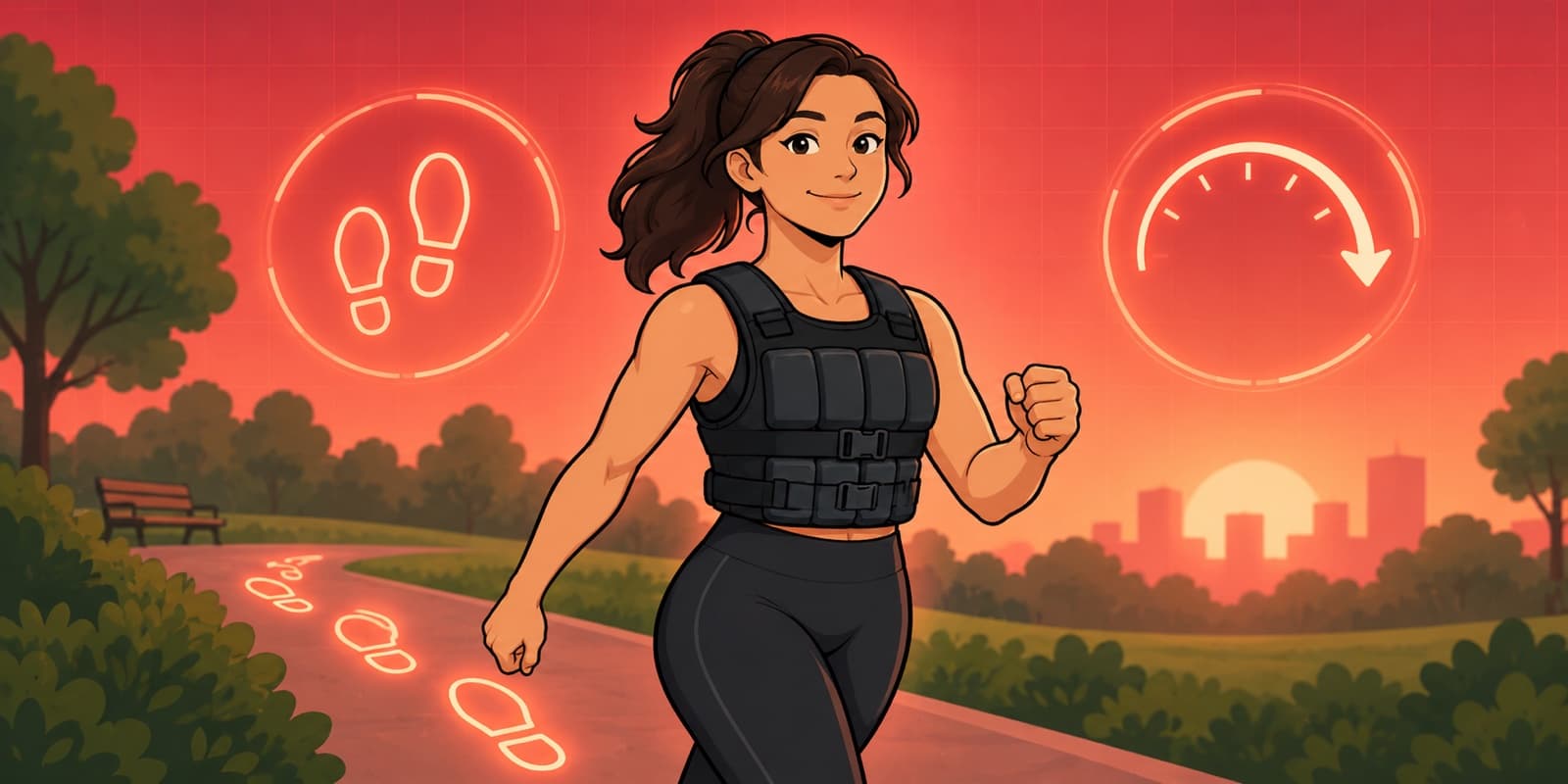
Load: weighted vests and rucking. Carrying weight raises the energy cost of walking approximately in proportion to the load. Military load-carriage research, which is where the equations come from, shows that a load of 10 percent of body weight raises the cost of walking by roughly 5 to 10 percent on the flat and more on hills (Pandolf et al. 1977). A vest also loads the legs, hips and trunk, which adds a mild strength and bone stimulus that unloaded walking lacks.
Practical guidance for rucking or vest walking:
- Start at 5 to 10 percent of body weight; go no higher than about 20 percent.
- Keep the load close to the body and high on the back.
- Build duration before load.
- Expect more fatigue and some soreness at first; this is no longer "free" cardio.
- Skip it if you have back, hip or knee problems that loading aggravates.
Where HIIT does win
Walking is the fat-loss winner for most people. It is not the fitness winner. If your goals include a higher VO2 max, better performance in a sport, or the specific health benefits of high-intensity work, one interval session a week is worth including. HIIT is also the better choice when time is the binding constraint and you can tolerate the recovery cost. See VO2 Max: Why It Predicts Longevity for the protocol.
A sensible structure for someone losing fat while lifting: walk daily, lift three or four times a week, do one interval session if you want the fitness. Not four HIIT classes and no walking.
Fasted walking and the fat-burning zone
You burn a higher proportion of fat during fasted, low-intensity exercise. You do not lose more fat over weeks. Trials comparing fasted and fed cardio at matched calories find identical fat loss (Schoenfeld et al. 2014). The body balances the books over 24 hours, not during the session. Walk when you will walk.
Making it stick
The advantage of walking is adherence, so protect it:
- Anchor it to existing habits: a morning walk before work, a walk after dinner, walking phone calls.
- Break it up. Three 20-minute walks burn what one hour does.
- Track steps and set a daily floor, not a lofty target you hit twice a week.
- Use the incline treadmill on bad-weather days with a podcast.
- Treat rest days from lifting as walking days, not couch days.
The bottom line
Walking beats HIIT for fat loss in most real lives because it burns meaningful calories every day without the recovery cost, appetite rebound or dropout that hard cardio brings, and because it leaves your lifting untouched. Aim for 8,000 to 12,000 steps a day, add incline or a light weighted vest when you want more, keep one interval session a week if you care about VO2 max, and let the diet and the lifting do the rest.
Sources
- Paluch AE, Bajpai S, Bassett DR, et al. "Daily steps and all-cause mortality: a meta-analysis of 15 international cohorts." The Lancet Public Health, 2022.
- Levine JA. "Non-exercise activity thermogenesis (NEAT)." Nutrition Reviews, 2004.
- Keating SE, Johnson NA, Mielke GI, Coombes JS. "A systematic review and meta-analysis of interval training versus moderate-intensity continuous training on body adiposity." Obesity Reviews, 2017.
- Pontzer H, Durand R, Wood BM, et al. "Constrained Total Energy Expenditure and Metabolic Adaptation to Physical Activity in Adult Humans." Current Biology, 2016.
- Pandolf KB, Givoni B, Goldman RF. "Predicting energy expenditure with loads while standing or walking very slowly." Journal of Applied Physiology, 1977.
- Schoenfeld BJ, Aragon AA, Wilborn CD, Krieger JW, Sonmez GT. "Body composition changes associated with fasted versus non-fasted aerobic exercise." Journal of the International Society of Sports Nutrition, 2014.
- Wilson JM, Marin PJ, Rhea MR, et al. "Concurrent training: a meta-analysis examining interference of aerobic and resistance exercises." Journal of Strength and Conditioning Research, 2012.
Frequently asked questions
How much walking do I need to lose weight?
Walking alone will not create a deficit unless you also manage food, but 8,000 to 12,000 steps per day adds roughly 300 to 500 calories of expenditure over a sedentary baseline for most adults. Combined with a modest dietary deficit, that supports about 0.5 kg of fat loss per week.
Is walking better than HIIT for fat loss?
Per minute, HIIT burns more. Per week, walking usually wins, because it can be done daily without recovery cost, does not interfere with strength training, and people stick to it. Trials matched for total work find similar fat loss; real-world adherence tips the balance toward walking.
How many calories does walking burn?
Roughly 0.7 to 1.0 calories per kilogram of body weight per kilometre on the flat. A 75 kg person burns about 55 to 75 calories per kilometre, or 300 to 400 for 10,000 steps beyond a sedentary baseline. Incline and added load increase it substantially.
Does a weighted vest help fat loss?
It raises the calorie cost of walking by roughly 5 to 10 percent for every 10 percent of body weight carried and loads the legs and core more. Start at 5 to 10 percent of body weight, keep it under 20 percent, and expect more fatigue than unloaded walking.
Do I burn more fat walking on an empty stomach?
You burn a higher proportion of fat during a fasted walk, but total fat loss over weeks is the same as fed walking when calories are equal. Walk whenever you will actually do it.
Can walking replace strength training?
No. Walking does not build or preserve muscle in a deficit the way lifting does. The combination of daily walking and two to four lifting sessions a week is the most effective and most sustainable fat-loss setup for most people.