Cardio vs. Weights for Fat Loss
9 min read · September 2026 · by Manikanta Sirumalla
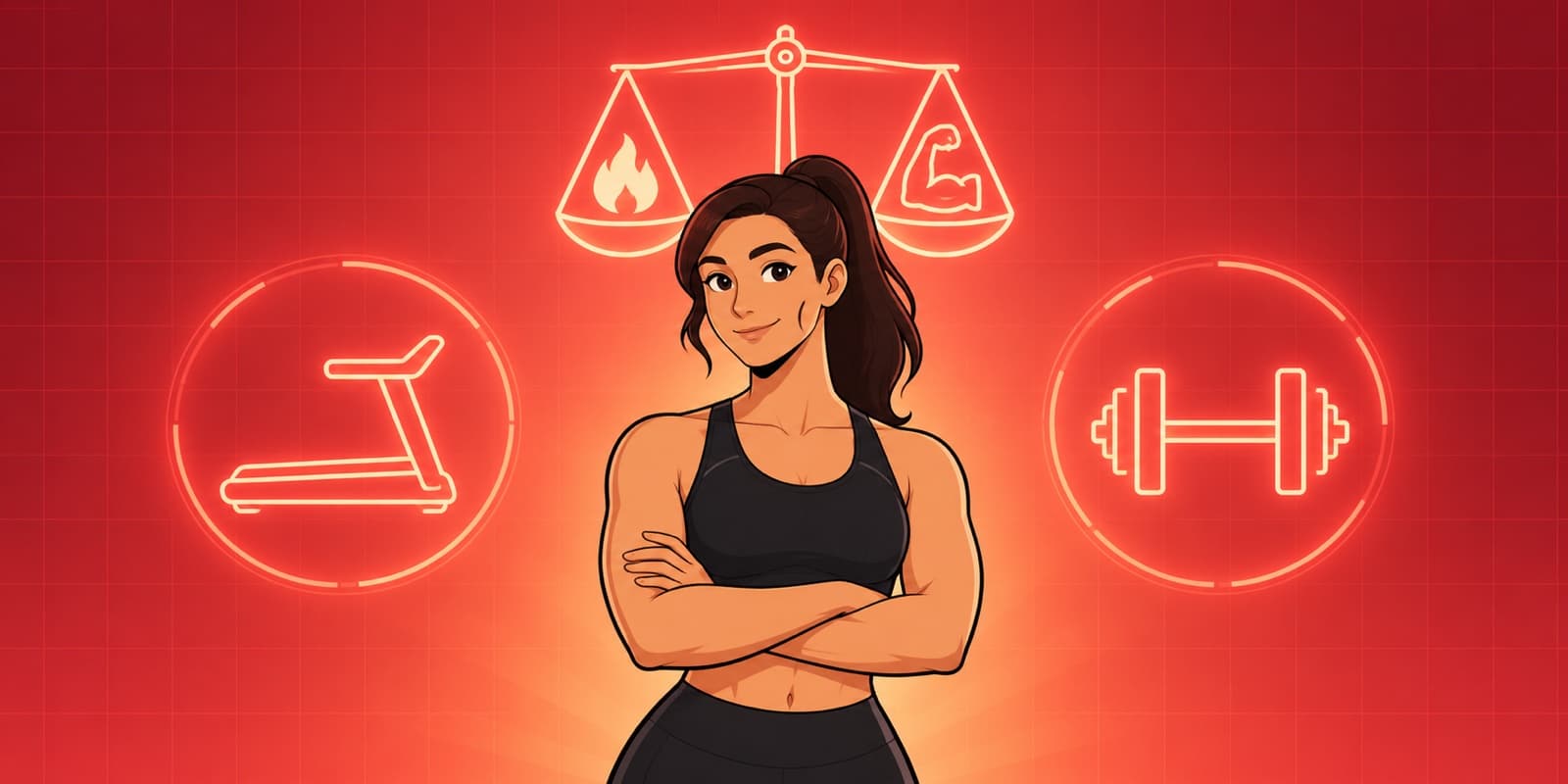
Ask a runner and a powerlifter how to lose fat and you get two confident, opposite answers. The research has actually tested this directly, in trials that assigned people to cardio only, weights only, or both for months at a time. The result is not a tie. It is a specific answer that most people in the argument are not giving.
First: the deficit does the work
No form of exercise causes fat loss on its own. Fat is lost when you burn more energy than you eat, sustained over weeks. Exercise is one lever on the "burn" side of that equation; food is the much bigger lever on the "eat" side, because it takes an hour of hard running to cancel one large pastry. See Calorie Deficit vs. Surplus.
This matters because most cardio-for-fat-loss disappointment comes from a math problem, not a training problem. People burn 400 calories, eat back 500 in compensatory hunger, and conclude cardio does not work. The body also partly compensates for exercise by moving less the rest of the day, an effect documented in studies of daily energy expenditure (Pontzer et al. 2016). Exercise still helps. It just helps less than the treadmill display claims.
So the real question is not "which burns more" but "within a deficit, which form of training gets you to the body you actually want?"
What the head-to-head trials show
The best-known direct comparison is the STRRIDE AT/RT study at Duke, which randomised 234 overweight adults to eight months of aerobic training, resistance training, or both, with no dietary intervention (Willis et al. 2012).
- Aerobic only lost the most fat mass and total weight, but also lost a little lean mass.
- Resistance only gained lean mass and lost almost no fat, because the calorie burn of lifting alone was too small to create a deficit without diet.
- Combined lost as much fat as aerobic only, and gained lean mass at the same time. It produced the best body composition, at the cost of the most training time.
That pattern repeats across the literature. A 2021 umbrella review of exercise for weight loss concluded that aerobic training reduces body weight and fat, resistance training preserves or increases lean mass and reduces fat when combined with diet, and combined training produces the best overall composition (Bellicha et al. 2021). A 2022 meta-analysis found resistance training alone produced meaningful body fat reductions, even though it rarely moved the scale much, because muscle was replacing fat (Wewege et al. 2022).
Translation: cardio wins on scale weight, lifting wins on what the weight is made of, and both together win on the thing you actually care about.
Why lifting matters more than its calorie burn suggests
A typical strength session burns 200 to 400 calories. An hour of steady running burns 500 to 800. On session calories, cardio wins easily, and the "afterburn" from lifting does not close the gap; excess post-exercise oxygen consumption after a hard session is real but usually under 100 calories.
Lifting's value in fat loss lies elsewhere:
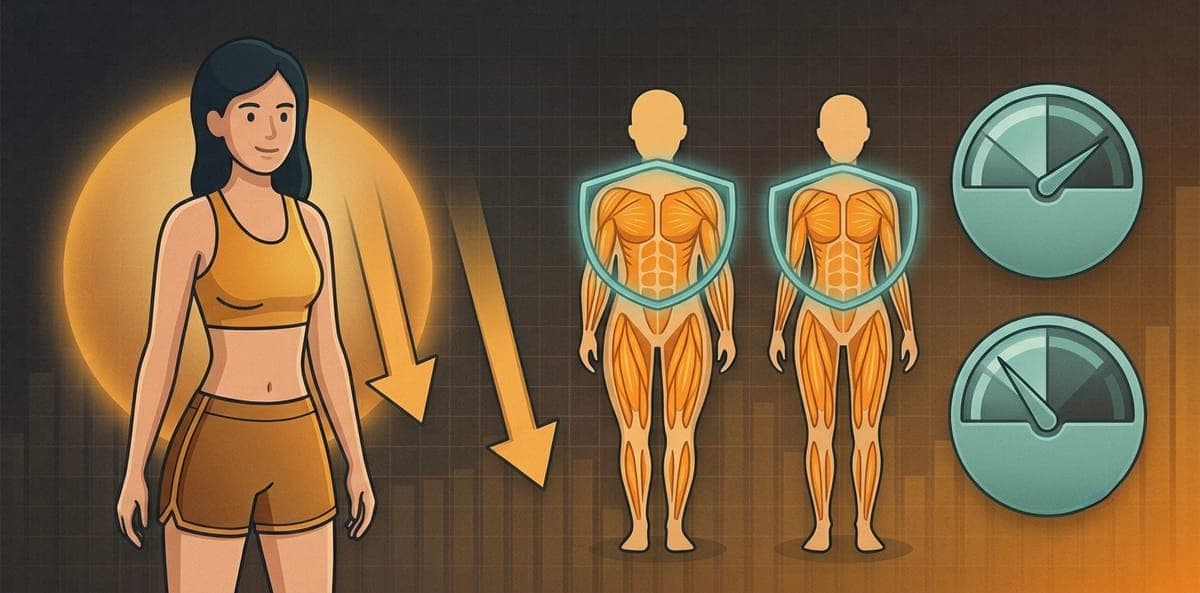
Muscle preservation. In a deficit, the body will break down muscle for fuel unless it has a reason not to. Resistance training is that reason. Diet-only weight loss typically loses about 25 percent of the weight as lean mass; adding resistance training and adequate protein cuts that to close to zero (Bellicha et al. 2021). Keeping muscle is what makes the end result look "toned" rather than smaller-but-soft.
Metabolic rate. Muscle costs some energy to maintain at rest, roughly 13 calories per kilogram per day, so keeping 3 kg more of it is worth about 40 calories a day, forever. A modest number, but it compounds, and it is the opposite of the metabolic slowdown that comes with losing muscle.
Strength for everything else. Strength lets you walk further, carry more, and do harder cardio. It also predicts long-term health independently of fat. See Strength Training for Longevity.
Insulin sensitivity. Both types of exercise improve it, and the combination improves it most.
Why cardio still earns its place
Cardio's contribution is exactly what it looks like: energy expenditure, and cardiovascular fitness, which matters for health regardless of fat. Three hours a week of easy cardio can add 1,500 to 2,000 calories of expenditure, which is a meaningful share of a weekly deficit and lets you eat more food while losing fat, an advantage for adherence and for keeping training quality high.
The type of cardio matters for how well it coexists with lifting:
- Walking and incline walking. Lowest recovery cost, easy to do daily, negligible interference with lifting. The best default. See Walking for Fat Loss.
- Zone 2 cycling or rowing. Low impact, moderate calorie burn, small interference with leg training. See Zone 2 Training.
- Running. High calorie burn, higher impact and more interference with leg strength.
- HIIT. Burns a lot per minute and improves VO2 max, but it is fatiguing and competes with lifting for recovery. Trials comparing HIIT with steady cardio for fat loss find similar results when total work is matched (Keating et al. 2017; Wewege et al. 2017). Use it sparingly, for fitness rather than fat.
Belly fat specifically
You cannot choose where fat comes off. Spot reduction has been tested and does not work; fat is mobilised from the whole body in a pattern set by genetics and hormones. What both cardio and lifting do reduce is visceral fat, the deep abdominal fat that matters most for health. Aerobic exercise has somewhat stronger evidence for reducing visceral fat per unit of time, and the combination with resistance training performs best (Bellicha et al. 2021). See Visceral Fat.
Cardio or weights first?
If both have to share a session, lift first. Cardio beforehand reduces the load and reps you can handle, and strength is the quality you most need to protect in a deficit. The reverse order costs the cardio session a little but costs the lifting more. Better still, separate them: lifting in the morning and a walk in the evening, or alternating days. Concurrent-training research finds interference shrinks when sessions are separated by six hours or more (Wilson et al. 2012). See How Much Cardio While Building Muscle.
What a fat-loss week looks like
Assuming a diet-created deficit of 300 to 500 calories per day and protein at 1.8 to 2.4 g/kg:
- Lifting: 3 to 4 sessions per week, full body or upper/lower, keeping loads heavy. The goal is to hold strength, not to burn calories. See The Cutting Guide.
- Steps: 8,000 to 12,000 per day, the cheapest expenditure available.
- Cardio: 2 to 3 sessions of 30 to 45 minutes easy, on non-lifting days or hours apart.
- HIIT: optional, at most once a week, for fitness.
Adjust the cardio up if weight stalls for two weeks and you would rather move more than eat less. Do not adjust the lifting down; that is the part that is protecting the result.
The bottom line
Diet creates the deficit. Lifting keeps the muscle, and is the non-negotiable. Cardio adds expenditure and fitness, and works best when it is mostly easy and mostly walking. Do both, lift first, and judge the result by measurements and strength rather than the scale alone.
Sources
- Willis LH, Slentz CA, Bateman LA, et al. "Effects of aerobic and/or resistance training on body mass and fat mass in overweight or obese adults." Journal of Applied Physiology, 2012.
- Bellicha A, van Baak MA, Battista F, et al. "Effect of exercise training on weight loss, body composition changes, and weight maintenance in adults with overweight or obesity: An overview of 12 systematic reviews and 149 studies." Obesity Reviews, 2021.
- Wewege MA, Desai I, Honey C, et al. "The Effect of Resistance Training in Healthy Adults on Body Fat Percentage, Fat Mass and Visceral Fat: A Systematic Review and Meta-Analysis." Sports Medicine, 2022.
- Keating SE, Johnson NA, Mielke GI, Coombes JS. "A systematic review and meta-analysis of interval training versus moderate-intensity continuous training on body adiposity." Obesity Reviews, 2017.
- Wewege M, van den Berg R, Ward RE, Keech A. "The effects of high-intensity interval training vs. moderate-intensity continuous training on body composition in overweight and obese adults: a systematic review and meta-analysis." Obesity Reviews, 2017.
- Pontzer H, Durand R, Wood BM, et al. "Constrained Total Energy Expenditure and Metabolic Adaptation to Physical Activity in Adult Humans." Current Biology, 2016.
- Wilson JM, Marin PJ, Rhea MR, et al. "Concurrent training: a meta-analysis examining interference of aerobic and resistance exercises." Journal of Strength and Conditioning Research, 2012.
Frequently asked questions
Is cardio or weights better for losing belly fat?
Neither targets belly fat specifically, since fat is lost from the whole body in a genetically set pattern. Both reduce visceral (deep abdominal) fat when they create a deficit; aerobic exercise has slightly stronger evidence for visceral fat per se, and the combination beats either alone.
Should I do cardio or weights first?
Lift first if both are in the same session. Fatigue from cardio reduces the quality of your lifting more than the reverse, and strength is the thing you most want to protect in a deficit. Ideally, separate them by several hours or put them on different days.
Can I lose fat with only weights and no cardio?
Yes, if your diet creates the deficit. Resistance training alone reduces body fat in meta-analyses, and combined with a diet it preserves muscle far better than diet alone. Adding walking is the easiest way to raise expenditure without interfering with recovery.
Does lifting burn as many calories as cardio?
No. A typical strength session burns roughly 200 to 400 calories; an hour of running burns 500 to 800. The afterburn (EPOC) from lifting is real but small, usually under 100 calories. Lifting's contribution to fat loss is muscle retention and long-term metabolism, not session calories.
Is HIIT better than steady cardio for fat loss?
Per minute, HIIT burns more, but total fat loss in trials is similar when total work is matched, and HIIT is harder to recover from alongside lifting. Steady easy cardio and walking win on adherence and on compatibility with strength training for most people.
Why am I not losing weight with cardio?
Usually because the extra calories are being eaten back, either deliberately or through appetite, and because the body partly compensates by moving less the rest of the day. Track intake, add lifting, and treat cardio as a modest contributor rather than the whole strategy.